
You sat through the ServiceTitan demo. Then the number came, some flavor of “a few hundred a tech, plus setup, on a twelve-month agreement,” and you did the math while the rep kept talking. For a three-truck shop that is a truck payment every month for software. So you type “ServiceTitan alternative for small shop” into your phone, and every result is a listicle written by someone who never dispatched a call in July.
Here is the short version. The best ServiceTitan alternative for most small HVAC shops in 2026 is not the cheapest tool on the list, it is the one whose pricing model fits how you grow, and for a 2 to 15 truck shop that usually means Housecall Pro or Jobber for published per-seat pricing, or Service Fusion if you plan to add techs fast and want flat unlimited-user billing. But there is a bigger point most lists miss: the money in a small shop leaks before the field software ever touches it, back at the phone. This post walks all five alternatives across eight criteria, tells you who each fits, and shows you where the real leak is.
On this page
- Why small shops start shopping for a ServiceTitan alternative
- The eight criteria that actually matter
- The five real alternatives, one by one
- The alternatives compared at a glance
- Which one fits: solo, 5 techs, 12 techs
- The leak every alternatives list ignores
- How to switch without losing your data
- The 10DLC bill every texting shop pays
- Objections and honest answers
- Frequently asked questions
Why small shops start shopping for a ServiceTitan alternative
ServiceTitan is a real platform, deep and polished, and for a shop running 25 trucks it can pay for itself. The problem is not the software. It is the fit.
Two things send small shops to the exit. The first is the pricing model: ServiceTitan bills per technician, so every hire is a permanent raise on your software bill. Contractors report $245 to $500 per tech per month plus an implementation fee that starts around $5,000, on a 12-month contract, all user-reported because ServiceTitan does not publish a price (Projul, 2026; Tooled Up Pro, 2026).
The second is that ServiceTitan is now a public company, on the Nasdaq as TTAN after its December 12, 2024 IPO at $71 a share (CNBC, 2024), which means pressure on revenue per customer. For a 2 to 15 truck shop, that combination is usually more system, and more cost, than the work requires. Judge the alternatives on how they hold up in August, not on the demo.
The eight criteria that actually matter
A two-tool “vs” article is easy to write and useless to read. To actually choose, score each option on the things that bite a small shop later, not the feature list on the demo. Here are the eight I use.
- Pricing model. Per technician or per company? This drives your bill more than any feature.
- Published pricing. Can you see the price without a sales call?
- Contract and lock-in. Month-to-month, or a 12-month agreement with auto-renewal?
- Setup and time to live. A weekend, or a months-long implementation you pay for while learning it?
- HVAC fit. Maintenance agreements, dispatch, equipment history: built for the trade or bent to fit?
- Texting and follow-up. Can it text customers back and request reviews, and is it 10DLC compliant?
- Migration and data export. How hard is it to get your data in, and back out if you leave?
- Who it actually fits. Every tool is right for somebody and wrong for somebody else.
Score every option against those eight and the choice stops being about who had the slicker demo.
The five real alternatives, one by one
Housecall Pro
The most popular small-shop alternative, and it publishes its pricing. Tiers run Basic at $59 a month billed annually ($79 monthly) for one user, Essentials at $149 for up to five users, and Max at $299 with eight users included and extra seats around $35 each (Housecall Pro pricing; Projul, 2026). Month-to-month, and setup takes days.
Where it bites: the add-on trap. Advanced reporting, sales proposals, and dedicated onboarding live on higher tiers or as paid extras, so the plan you start on is rarely the plan you end on. Fits: a residential shop that wants a clean, published-price tool live this week without enterprise depth.
Jobber
Also published, also month-to-month, popular with smaller shops. Billed monthly the tiers run Core $49, Connect $139, Grow $199, and Plus $599, with one user on Core and rising seat counts up the ladder, plus extra seats around $29 each (Jobber pricing; Costbench, 2026). Clean product, strong on quoting.
Where it bites: it started as a general home-service tool, not HVAC-first, so maintenance-agreement and equipment-history workflows are lighter than a trade-specific platform. Fits: a small, growing shop that wants a simple tool and does not live by maintenance-plan tracking.
Service Fusion
The one that prices differently, and the reason a small shop should have this conversation at all. Now under EverCommerce’s EverPro brand, it charges per company, not per user: three flat tiers at roughly $208 (Starter), $324 (Plus), and $533 (Pro) a month billed annually, all with unlimited users (Capterra, 2026; EverCommerce). A 3-tech shop and a 30-tech shop pay the same base. Built for the trades, with dispatch and job costing HVAC shops recognize.
Where it bites: it costs more than Jobber or Housecall Pro at a single seat, so a solo operator overpays. Fits: a shop that plans to add trucks and wants its bill to stop punishing every hire.
FieldEdge by Xplor
A Xplor Technologies platform now, branded “FieldEdge by Xplor” (Xplor press), aimed at established HVAC and plumbing shops that want QuickBooks-tight accounting. Contractors report around $125 per technician per month plus office-user seats and a setup fee (Workyard review), but like ServiceTitan it hides its price behind a demo, so treat any number as user-reported.
Where it bites: you invest a day evaluating it before anyone names a price, and the per-tech model carries the same growth-tax problem as ServiceTitan. Fits: an established shop that runs everything through QuickBooks and wants the accounting integration above all.
The ones the lists skip
Most “best alternatives” posts stop at four names. Successware has deep legacy penetration in HVAC and strong accounting, a real competitor the obvious lists ignore. FieldPulse and Workiz are lighter, published-price tools worth a demo; Simpro leans commercial. None changes the lesson: the pricing model matters more than the logo.
The alternatives compared at a glance
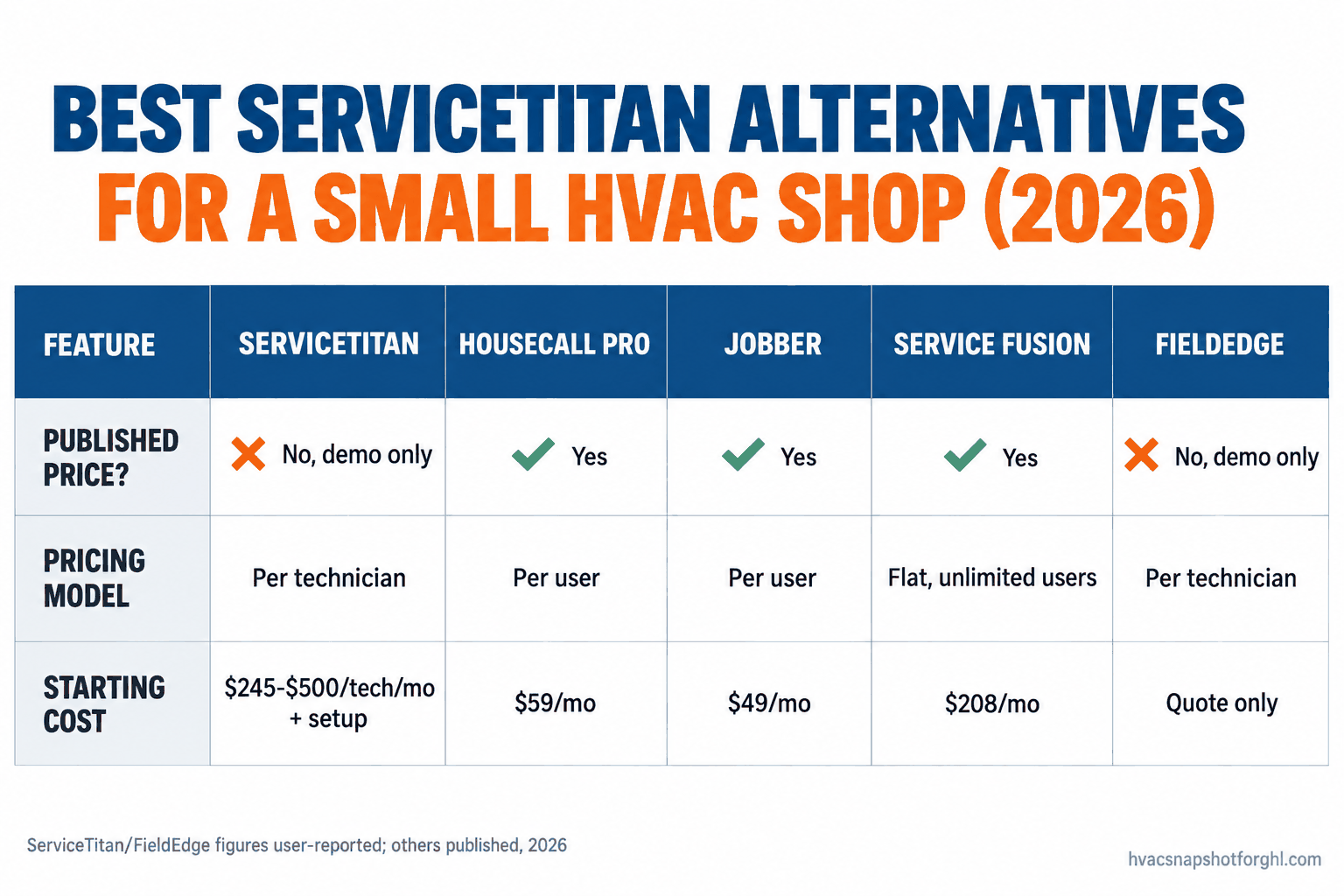
Best ServiceTitan alternatives for a small HVAC shop (2026)
| Platform | Published price? | Pricing model | Starting cost |
|---|---|---|---|
| ServiceTitan | No, demo only | Per technician | ~$245-$300/tech/mo + setup |
| Housecall Pro | Yes | Per user, tiered | $59/mo (annual) |
| Jobber | Yes | Per user, tiered | $49/mo |
| Service Fusion | Yes | Flat, unlimited users | ~$208/mo |
| FieldEdge by Xplor | No, demo only | Per technician (reported) | Quote only |
Now put a dollar figure on it: roughly what a 5-tech shop pays per year, using published rates and, for ServiceTitan, the user-reported mid-tier.
Which one fits: solo, 5 techs, 12 techs
The right answer changes with your truck count. Run the eight criteria at three sizes and the winner moves.
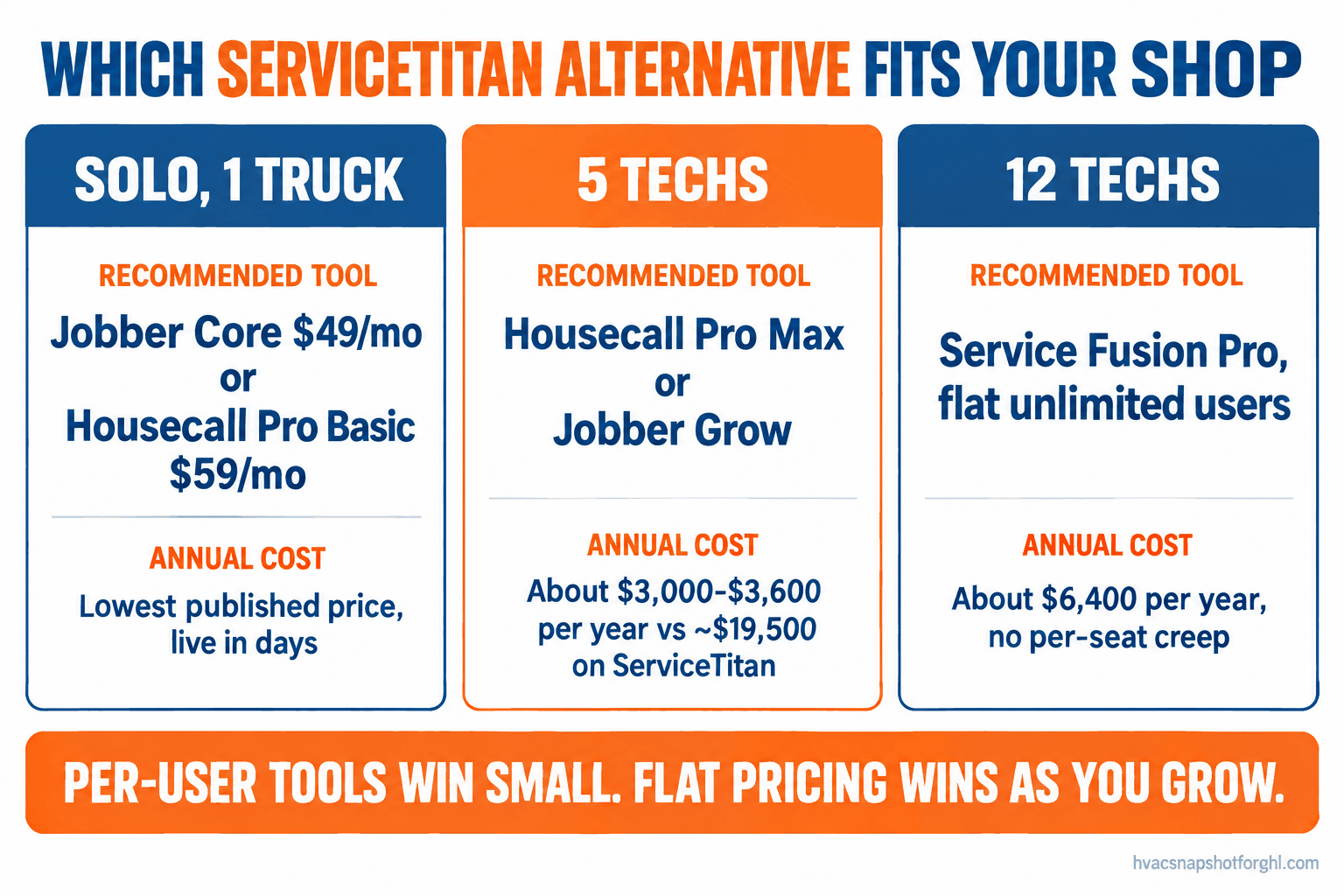
Solo operator, one truck. You want the lowest published price and fastest setup. Jobber Core at $49 or Housecall Pro Basic at $59 cover scheduling, invoicing, and payments for one user. ServiceTitan is overbuilt here. Winner: Jobber or Housecall Pro.
Five techs. Still the per-user tools, and it is not close. Five seats fit inside Housecall Pro Max ($299/mo, 8 users) or Jobber Grow ($199/mo, 10 users), so you are around $3,000 to $3,600 a year against roughly $19,500 on ServiceTitan. If you are hiring hard, look at Service Fusion now so you switch once, not twice.
Twelve techs. Here per-seat pricing starts to sting: on Jobber you are into Plus at $599 a month, on Housecall Pro you are buying extra seats. Service Fusion Pro at roughly $533 a month with unlimited users stops the creep cold. ServiceTitan is defensible if you use its depth, but the user-reported bill is near $47,000 a year. Winner: Service Fusion. The pattern: per-user tools win small, flat pricing wins as you grow.
The leak every alternatives list ignores
Here is the part that never makes the listicle, and it matters more than which tool you pick. Field service software manages a job you already booked; it does not book the job. For most small shops, the money does not leak inside the FSM tool. It leaks upstream, at the phone.
Picture a July afternoon. Your tech is up a ladder, the office line rings, and it goes to voicemail. That caller does not leave a message. They dial the next shop on Google, and the install is theirs. No dispatch board recovers a call nobody answered.
The numbers on this are old and brutal. Harvard Business Review’s classic study found firms that respond to a new lead within an hour are about 7 times more likely to have a meaningful conversation with a decision-maker than those that wait even two hours (HBR, 2011). The MIT lead-response study behind the “five-minute rule” found contacting a web lead within five minutes versus thirty makes you roughly 21 times more likely to qualify it (MIT/Oldroyd study). Speed to the lead is the whole game, and none of these five platforms answers your phone after 5pm.
This is why the smartest small shops pair a right-sized field tool with a front-of-funnel system that books the job. What recovers revenue is a missed-call text-back and an AI receptionist covering the calls your office cannot. We break down where jobs leak in the HVAC lead leak audit, and the fix is a done-for-you automation system built on GoHighLevel that sits in front of whatever FSM tool you choose. (Disclosure: that is our GoHighLevel affiliate link. It costs you nothing extra.)
How to switch without losing your data
Picking the new tool is the easy part. The switch is where shops get hurt, so here is the plan, with the failure modes that cost real money.
Get the exit terms in writing before you sign. Annual contracts commonly auto-renew with a 30 to 60 day cancellation window, and contractors report four- and five-figure early-termination demands and 15 to 20 percent renewal hikes (Projul, 2026). Diary that window.
Export your data before you cancel anything. Pull your customer list, job history, equipment records, and photos out first, in a format you can import. A tool you cannot cleanly leave can raise your rate at renewal and dare you to move.
Run both systems for two weeks. Do not flip a switch on a Monday in July. Overlap them long enough to catch what did not migrate.
Here is the email to send every vendor, old and new, before you commit. Steal it word for word.
The vendors worth your money answer all six in a reply. The ones that keep you in the demo just told you what you needed to know.
And while you move the data, wire up the message that recovers the most revenue for the least effort: the missed-call text-back.
That one automation turns a missed call into a text thread instead of a lost job, no matter which field tool you land on.
The 10DLC bill every texting shop pays
One cost follows you to every platform, because the phone carriers set it, not the software vendor. The moment you send business texts in the US you are in A2P 10DLC territory and pay registration and per-message fees on top of your subscription.
The pieces are small but real: a one-time registration of about $24.50 for a low-volume sole proprietor or $71.91 for a standard high-volume brand, a per-campaign monthly fee of $2 to $10, and a per-message carrier surcharge around $0.003 per segment (GoHighLevel 10DLC fees). Same bill whether you text through Housecall Pro, Jobber, Service Fusion, or a GoHighLevel build.
The part that actually bites is compliance, not the surcharge. Texting customers without proper consent and a clean opt-out is a TCPA exposure, and the penalties dwarf the carrier fee. Get consent and registration right once and the ongoing cost is trivial. We lay out the exact consent wording in the HVAC TCPA and 10DLC guide.
Objections and honest answers
“I already pay for ServiceTitan. Am I wasting money?” Not necessarily. If you run enough trucks to use its depth, the per-tech cost can pay for itself. The waste is paying enterprise per-tech pricing for a shop that opens a fraction of the platform. If the gap to a published-price alternative is five figures, that is your answer.
“Isn’t cheaper software just worse software?” Price and pricing model are two different things. Service Fusion is not cheaper because it is worse; it is cheaper for a growing shop because it charges per company instead of per seat. Match the tool to your truck count.
“Does the field software fix my missed calls?” No, and this is the one that matters. None of these five answers your phone after hours or texts a caller back on its own. Pick the right-sized field tool, then put a system in front of it that captures the work you are losing.
The bottom line
The best ServiceTitan alternative for a small HVAC shop is the one whose pricing model matches how you grow. Solo and small, take Jobber or Housecall Pro. Growing fast, take Service Fusion’s flat pricing before per-seat creep catches you. Whatever you choose, the field software only manages jobs you already won. The jobs you are losing are back at the phone. That is the leak worth fixing first.
Frequently asked questions
ServiceTitan alternatives for HVAC, common questions
What is the best ServiceTitan alternative for a small HVAC shop?
For most 2 to 15 truck shops, it is Housecall Pro or Jobber for published per-user pricing, or Service Fusion for flat, unlimited-user billing if you plan to add techs fast. Housecall Pro runs $59 to $299 a month, Jobber $49 to $599, and Service Fusion around $208 to $533 a month per company.
How much does ServiceTitan cost compared to the alternatives?
ServiceTitan does not publish pricing, so every figure is user-reported: roughly $245 to $500 per technician per month plus a $5,000+ implementation fee, on a 12-month contract (Projul, 2026). A 5-tech shop pays about $19,500 a year, versus roughly $2,400 to $3,900 on published-price alternatives.
Is Service Fusion or Housecall Pro cheaper for a growing HVAC shop?
It depends on tech count. Housecall Pro (per user) is cheaper at a few seats because five techs fit inside its Max plan. Service Fusion charges per company with unlimited users, so it wins once you outgrow a per-user plan's included seats, usually around ten or more techs.
Why does FieldEdge hide its pricing?
FieldEdge by Xplor is demo-gated like ServiceTitan. Contractors report around $125 per technician per month plus office-user seats and a setup fee, but treat that as user-reported. Ask for the per-tech rate, setup fee, and contract length in writing before you evaluate it.
Will switching field service software fix my missed calls?
No. It manages jobs you already booked; it does not answer your phone after hours. Firms that respond within an hour are about 7 times more likely to reach the buyer (HBR, 2011), so the biggest leak is usually the phone, not the FSM tool. Our lead leak audit shows where.
About the author
Tony Escalante is an HVAC Operations and Dispatch Strategist based in Phoenix, AZ. He spent a decade running the service board for a multi-truck residential cooling shop before moving into systems work. He writes about turning chaotic summer call volume into bookable, trackable jobs, and why the phone, not the wrench, is where most HVAC revenue leaks.