
It is the second week of a heat wave. Your phone log reads like a good day: 38 inbound calls, a full board, three techs running flat out. Then Friday’s deposits hit the bank and the number is smaller than it should be. You booked the calls you answered. The problem is all the ones you never see, the jobs that leaked out between the phone ringing and the money landing, and never showed up on any report you look at.
Here is the short version: a small HVAC shop rarely has a lead-generation problem. It has a lead-leak problem. You are already paying to make the phone ring. The jobs you lose do not vanish at the top of the funnel where you can see them. They drain out of six specific gaps further down, one at a time, quietly, all year. This is the audit that finds them: six gaps, what leaks out of each, the real message copy to plug it, and how the fix changes whether you run one truck or fifteen.
On this page
- Why the phone rings all summer and the bank account looks thin
- The six gaps where HVAC leads leak
- Gap 1: The unanswered ring
- Gap 2: The slow first reply
- Gap 3: The booking friction
- Gap 4: The no-show
- Gap 5: The unsold estimate
- Gap 6: The one-and-done customer
- Run the audit for your size of shop
- Keeping the text plugs legal
- Objections I hear from owners
- Frequently asked questions
Why the phone rings all summer and the bank account looks thin
Call volume is a vanity number. Booked, completed, paid, and repeat work is the real business, and every step in between is a place a job can slip out. Owners obsess over the top of the funnel because it is the part they can see: the call count, the ad spend, the cost per lead. What you cannot see on any dashboard is the lead that rang once at 6:40pm, hit voicemail, and booked with the shop across town before you ever knew it existed.
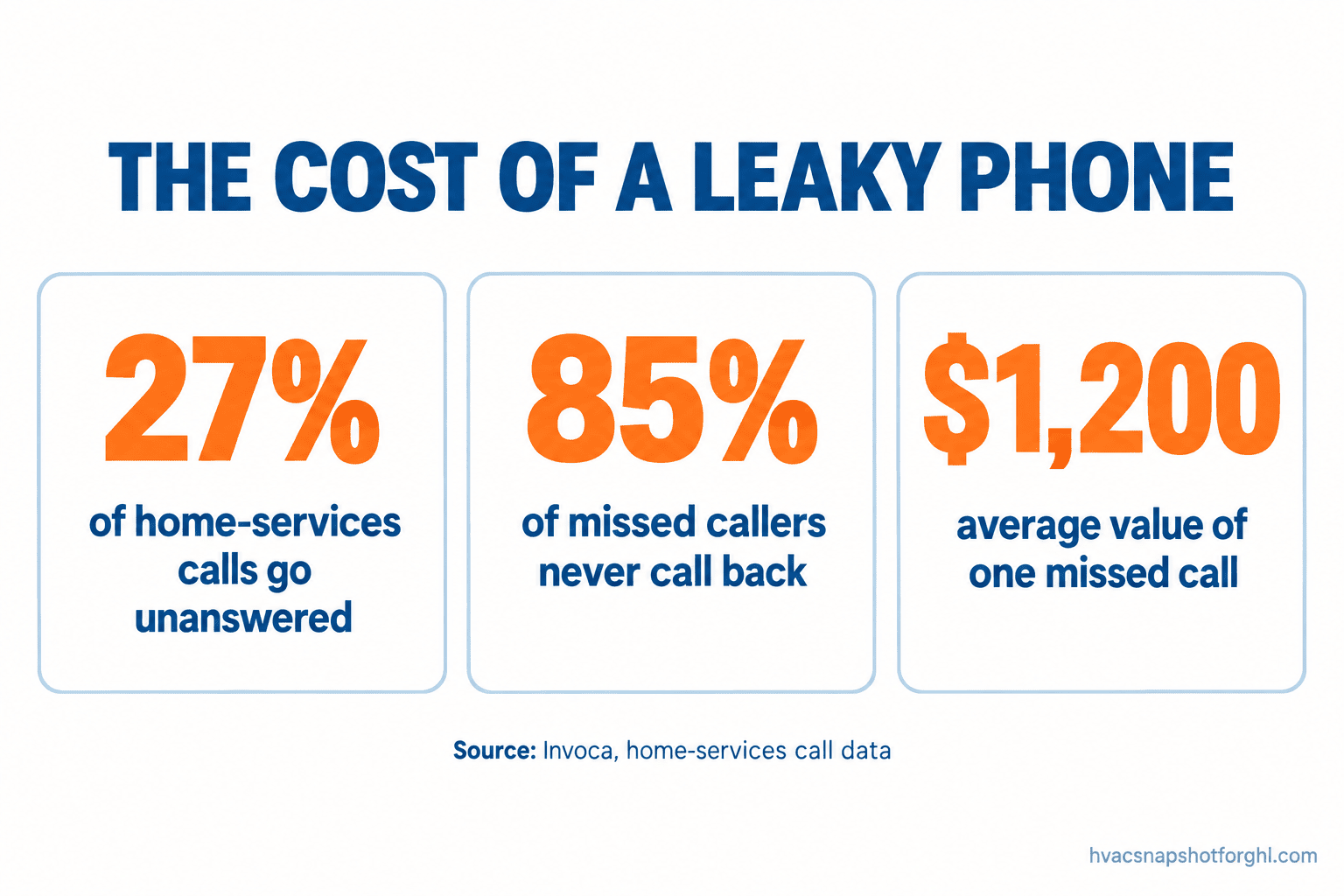
That invisible loss is bigger than most owners guess. Call-tracking data from Invoca puts the average value of a missed call in home services at roughly $1,200, and finds about 27% of inbound calls go unanswered while 85% of those callers never try again. And that is only the first gap. The lead that survives the ring can still die waiting for a callback, bail at a clunky booking step, no-show, or walk away from an unsold quote.
The six gaps where HVAC leads leak
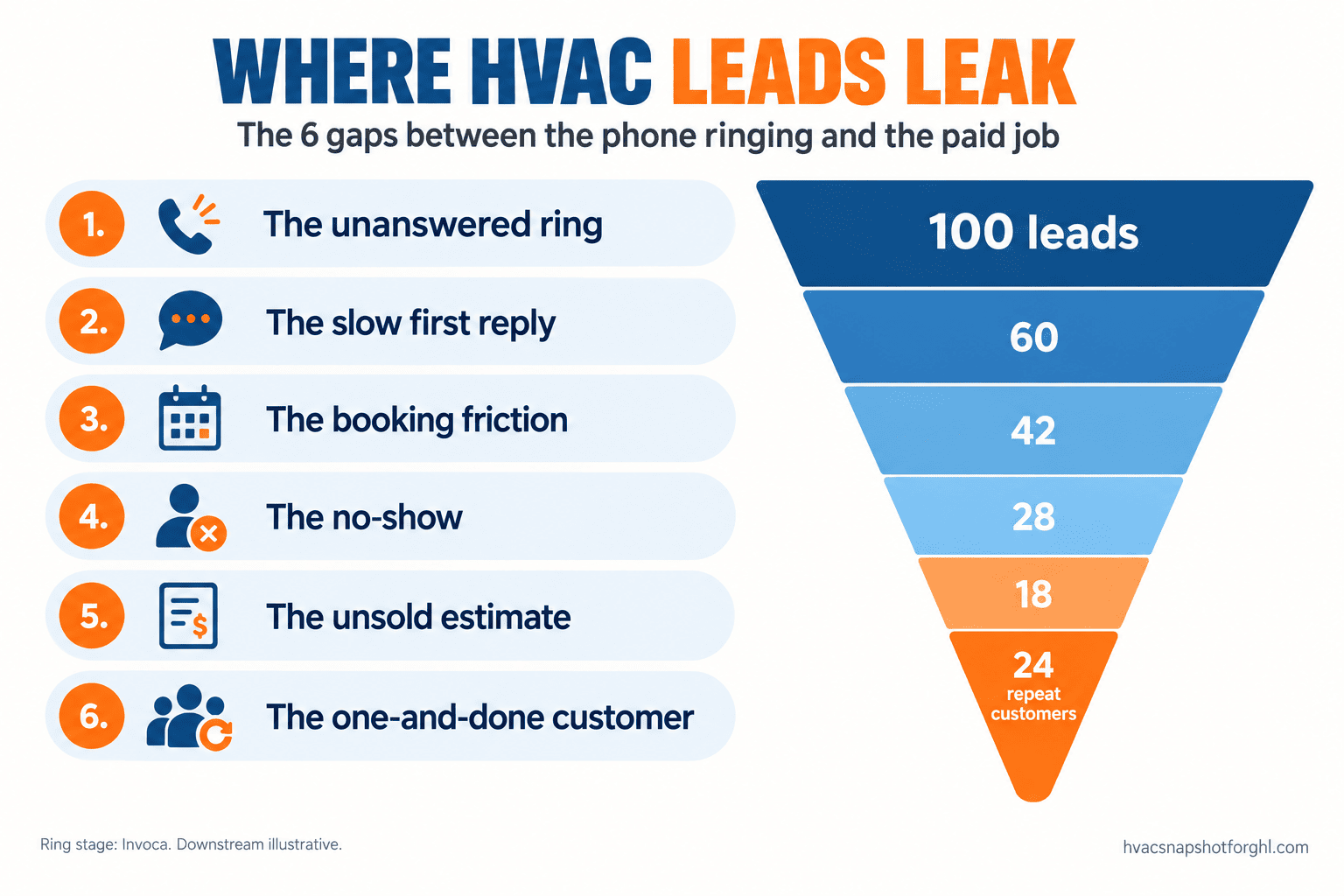
Picture 100 real leads entering your business in a busy month, calls and web forms combined. If you plug nothing, here is roughly how they drain before they ever become paid, repeat customers. The first stage is the sourced Invoca miss rate. The stages after it are illustrative, but every owner who has watched their own numbers knows the shape is right.
Twenty-four repeat customers out of a hundred leads. That is not a shop that needs more ads. That is a shop with six holes in the bucket. Here is the whole audit at a glance, then we walk each gap.
The six gaps at a glance
| Gap | What leaks out | The plug |
|---|---|---|
| 1. The unanswered ring | Calls that hit voicemail during a rush or after hours | Answer layer + missed-call text-back in under a minute |
| 2. The slow first reply | Web-form and voicemail leads that sit for hours | Instant auto-reply, then a human within minutes |
| 3. The booking friction | Callers who won't wait on hold to schedule | Self-book calendar with real service windows |
| 4. The no-show | Booked jobs that cancel or forget | Automatic confirmations and reminders |
| 5. The unsold estimate | Replacement quotes handed over and forgotten | A timed follow-up sequence on every open quote |
| 6. The one-and-done customer | Customers who never come back or refer | Review requests and maintenance-plan renewals |
Gap 1: The unanswered ring
The first and biggest leak is the call your team never picks up, because a phone that rolls to voicemail in this trade is a job handed to whoever answers next. On a slow Tuesday your office person catches everything. On the third day of a heat wave she is on a twelve-minute call talking a homeowner through a thermostat reset while calls three, four, and five stack up and roll over. Same desk, far worse coverage, at the exact moment demand peaks.
Per Invoca, roughly a quarter of inbound home-services calls go unanswered, 85% of voicemail callers never call back, and fewer than 3% leave a message. So the voicemail box you rely on to catch overflow is catching almost nothing. It breaks because you staff for an average day, not a peak one, and because nights and weekends roll straight to voicemail even though a 7pm Friday breakdown is prime booking time.
The plug is an answer layer with no ceiling of one, plus a missed-call text-back that fires the instant a call goes unanswered, inside 60 seconds:
This is the same leak we quantified for nights and weekends in After-Hours Missed Calls Are Costing HVAC Shops $40K+/Year. An AI receptionist picks up call number five while your person is on call number four, and it never sleeps through a Saturday.
Gap 2: The slow first reply
A lead that survived the ring can still die waiting, because a homeowner with no cooling in July is working down a list, and the first shop to reply usually wins. This leak eats web-form leads and voicemail callbacks alive. The lead is in your CRM. It just gets a reply too late to matter.
The research is blunt. The MIT / InsideSales Lead Response Management study, built on more than 15,000 leads, found that replying within 5 minutes instead of 30 made a firm about 21x more likely to qualify the lead and 100x more likely to connect. The Harvard Business Review audit of 2,241 companies found the average first response was 42 hours, and 23% of firms never responded at all. It breaks when the after-hours web lead sits until 10am, or the dispatcher means to call back after the rush and forgets.
The plug is an instant automatic reply that buys you time, followed by a real human touch inside a few minutes. The auto-reply is not the whole job. It keeps the lead warm until a person can close it. We broke the full cadence down in HVAC Lead Nurture and the raw speed math in HVAC Speed to Lead.
Gap 3: The booking friction
Even a lead you reach fast can leak if scheduling is a chore, because every step between “come fix it” and a locked appointment is a chance to lose them. Phone tag to find a window. Being told someone will “call you back to schedule.” A callback that lands while they are in a meeting. Each one is friction, and friction leaks.
Homeowners increasingly want to book the way they book everything else: on their own, without a phone call. When the only path to your calendar runs through one busy office person, your booking capacity is capped at whatever that person can handle. It breaks when the desk promises a window that is already full because nobody is looking at the live board, or when “we’ll call you to schedule” becomes a second lead to chase. We covered the true cost of phone-only booking in The Real Cost of Booking by Phone in 2026 and the self-serve fix in HVAC Online Booking.
The plug is a self-book calendar wired to real, honest service windows, so the customer picks a slot that is actually open and gets an instant confirmation. Appointment automation lets the homeowner schedule while your desk does the dispatching.
Gap 4: The no-show
A booked job is not a won job until the truck is in the driveway, and a silent calendar leaks appointments through cancellations, forgotten slots, and windows that quietly slide. This gap wastes drive time and burns a slot you could have sold to someone else. It breaks when the customer booked eight days ago and forgot, when nobody confirmed the morning of, or when the 2pm window slides to 4pm and the customer is annoyed before the tech even knocks.
The plug is the cheapest revenue protection on the list, because the job is already sold. You are just making sure it happens: an automatic confirmation on booking, a reminder the day before, and an “on the way” text with a live window the morning of.
Gap 5: The unsold estimate
This is the most expensive leak in the business and the one almost nobody watches: the replacement quote you handed over, the homeowner said “let me think about it,” and you never followed up. A $150 diagnostic that turns into a $7,500 system quote is the biggest number your shop touches all week, and most shops hand it over and hope. Hope is not a follow-up plan.
Replacement decisions are slow. The homeowner is getting two or three quotes, talking to a spouse, checking financing. The shop that stays politely in front of them during that window is the one that closes. It breaks when the quote lives on a clipboard or in the tech’s truck, never entered with a follow-up date, so nothing reminds anyone to check back. The owner assumes “if they want it, they’ll call,” which is exactly backwards, and the estimate ages out while the customer books with the shop that called them on day three.
The plug: every quote over a threshold gets entered as an open opportunity with an automatic sequence that mixes a text, a human call task, and an email with financing. Here is the cadence to steal:
Plug this one gap and you add zero leads. You just close more of the biggest tickets you already earned the right to quote. If you sell equipment, this is where the money is.
Gap 6: The one-and-done customer
The last leak is the customer who was happy with the work and you never heard from again, because a shop that treats every job as a one-time transaction leaves its best, cheapest revenue on the table. Winning a brand-new customer costs a full cost per lead. Getting a happy existing customer to come back costs a text. Yet most shops do neither the review request nor the rebook.
Two things leak here. First, the review you never asked for, which is the free marketing that wins your next customer in local search and holds your ground against the private-equity roll-up across town outspending you on ads. Second, the maintenance plan or seasonal tune-up you never offered, which is the recurring revenue that carries you through a quiet February. It breaks when the tech finishes, packs up, and drives off without the ask. We covered the review engine in HVAC Google Reviews and the recurring-revenue play in How to Sell Maintenance Plans Without Sounding Pushy.
Notice the review message routes an unhappy customer to reply privately first. That keeps a bad day off your public profile and gives you a shot to fix it, which is the whole game with reputation.
Run the audit for your size of shop
The six gaps are the same at every size. Which ones bleed worst, and what the fix looks like, depends on how many trucks you run.
The solo operator, one or two trucks. You are the tech, the dispatcher, and the salesperson. Your worst leaks are Gaps 1 and 2, because you cannot answer the phone with your hands in a condenser. You do not need a call center, you need automation that answers and books while you work. Start with missed-call text-back and a self-book calendar. Keep the unsold-estimate follow-up simple: three automatic texts and one reminder to call, since you are the one making that call.
The 5-truck shop. You have an office person, so the leaks move downstream. Gaps 3, 4, and 5 are where you lose the most, because the volume is past what one person can chase by hand. Your desk person is booking, dispatching, and texting techs, so quote follow-ups and reminders never happen consistently. This is the size where a full system pays back fastest: let automation own the reminders and the unsold-quote sequence so your office person can talk to customers who are ready to buy.
The 12 to 15 truck shop. You are big enough that the roll-up across town treats you as competition, and Gap 6 is your battleground. The review engine and the maintenance-plan renewals are how you defend market share against a consolidator with a bigger ad budget. You have probably plugged the front of the funnel already. Audit the back: how many quotes went unsold with zero follow-up last quarter, and how many completed jobs never got a review request.
Every owner I talk to wants to spend the fix money at the top of the funnel, on more ads. Almost every one of them is leaking worse at the bottom, on quotes they already earned and customers they already won. Plug the bottom first. It is cheaper and it pays back faster.
Keeping the text plugs legal
Half of these plugs are text messages to customers, and in the United States that puts you under TCPA and A2P 10DLC, so the fix has to be built to those rules. This is not as scary as it sounds, but you cannot skip it.
Business texting through any modern platform runs over A2P 10DLC, which means you register your business and your messaging use case with the carriers. Expect a modest one-time registration fee, a small monthly per-campaign fee, and a fraction of a cent in carrier surcharge per message. Those costs are small next to one recovered replacement job. The bigger rules are about consent: you need permission to text, every message needs a clear opt-out like “Reply STOP,” and you have to honor it immediately. That is why every template above carries the STOP line.
The refrigerant side of the trade is shifting at the same time, which is why replacement quotes feel like a moving target: the EPA’s phasedown of higher-GWP refrigerants under the AIM Act began restricting new equipment in 2025, so the quote you follow up on in Gap 5 has to be built on current equipment and pricing. We put the full plain-English texting rulebook in 10DLC + TCPA for HVAC Contractors. Read it before you turn any of this on. None of this is legal advice; confirm your setup with your platform and, if in doubt, counsel.
Objections I hear from owners
“Won’t customers find the automated texts annoying?” Only if they read like a robot. The templates above are written the way your best office person texts: short, specific, and useful. A homeowner whose AC just died is relieved to get a fast reply. The annoying version is the one that never comes, so they had to call your competitor to get help.
“I already pay for field service software. Doesn’t it do this?” Some of it, partly. Platforms like ServiceTitan and Housecall Pro are strong at dispatch, invoicing, and the job record. Most shops still have real gaps on the marketing-side plugs: instant missed-call text-back, the unsold-estimate sequence, and the review-and-rebook engine. We did the full teardown in What HVAC Software Really Costs in 2026. The point is not to rip anything out. It is to find which gaps your current stack leaves open.
“Do I need to be technical to run this?” No. The reason to install a prebuilt system is that the wiring is already done. You approve the message copy, point it at your calendar and phone number, and it runs.
“I’m a small shop. Is this overkill?” The opposite. A small shop feels every leak harder because you have fewer leads to lose. The solo operator who plugs Gaps 1 and 2 often sees the fastest payback of anyone, because a single recovered replacement job covers the cost many times over. This is the stack we walk through in 5 HVAC Automations That Pay for Themselves in 30 Days.
Frequently asked questions
Where do HVAC shops lose the most leads?
The biggest visible leak is the unanswered call: about 27% of inbound home-services calls go unanswered (Invoca), and 85% of those callers never call back. But the most expensive and least-watched leak is the unsold estimate, the replacement quote a shop hands over and never follows up on. Shops typically leak jobs at six points: the unanswered ring, the slow first reply, booking friction, the no-show, the unsold estimate, and the one-and-done customer.
How fast do I need to respond to an HVAC lead?
As close to instant as possible. The MIT/InsideSales study found replying within 5 minutes instead of 30 made a firm about 21x more likely to qualify a lead and 100x more likely to connect. HBR found the average first response was 42 hours and 23% of firms never responded at all. In a heat wave a homeowner calls down a list, so the first shop to reply usually books the job.
What does one missed call actually cost an HVAC shop?
Invoca estimates the average missed home-services call is worth about $1,200, and summer AC calls skew toward high-value replacement work worth far more. You also lose the ad money you already spent to make the phone ring. Because 85% of missed callers never try again, a missed call is usually a permanently lost job, not a delayed one.
How do I follow up on unsold HVAC estimates without being pushy?
Enter every quote over a set amount as an open opportunity with an automatic sequence: a same-day text with the quote and financing, a check-in around day three, a real phone call around day seven, and light touches at day fourteen and thirty. Big-ticket HVAC decisions are slow, so the shop that stays politely in front of the homeowner is the one that closes.
Are automated text messages to customers legal for HVAC shops?
Yes, when set up correctly. Business texting in the U.S. runs under TCPA and A2P 10DLC rules, which require registering your business and use case, getting consent to text, identifying your business, and honoring opt-outs like 'Reply STOP' immediately. Every template should include the opt-out line. This is not legal advice; confirm your setup with your platform and, if unsure, an attorney.
Related reading
- After-Hours Missed Calls Are Costing HVAC Shops $40K+/Year: Gap 1, quantified for nights and weekends.
- HVAC Speed to Lead: Why Minutes Decide the Booking: the research behind Gap 2.
- The Real Cost of Booking by Phone in 2026: the friction behind Gap 3.
- How to Sell Maintenance Plans Without Sounding Pushy: the recurring-revenue side of Gap 6.
- What HVAC Software Really Costs in 2026: where your current stack leaves gaps open.