
It is a Thursday in May, the first real hot spell of the year, and you are in a homeowner’s driveway writing a condenser replacement quote in your head. The number you wrote for the same 3-ton system last August does not work anymore. The equipment costs more, the refrigerant is different, and the distributor told you Tuesday the R-410A stock you were quoting from is gone. The homeowner asks why the neighbor paid less last year. That gap is what this post is about.
Here is the short version. Starting in 2025 the EPA capped the global warming potential of the refrigerant allowed in new residential AC and heat pumps, pushing the industry off R-410A and onto lower-GWP blends like R-454B and R-32. For your shop that means new equipment, new handling rules, higher and more volatile prices, and a customer who needs the change explained without getting scared off the sale. None of it stops you from selling. All of it changes how you quote and what you say.
On this page
- What actually changed, and when
- R-410A vs R-454B vs R-32, in plain terms
- Why your equipment quotes keep moving
- The six things the switch changes in your shop
- Where EPA 608 fits now
- Three shops, three ways this lands
- Steal this: what to tell the customer
- Objections and honest answers
- Frequently asked questions
What actually changed, and when
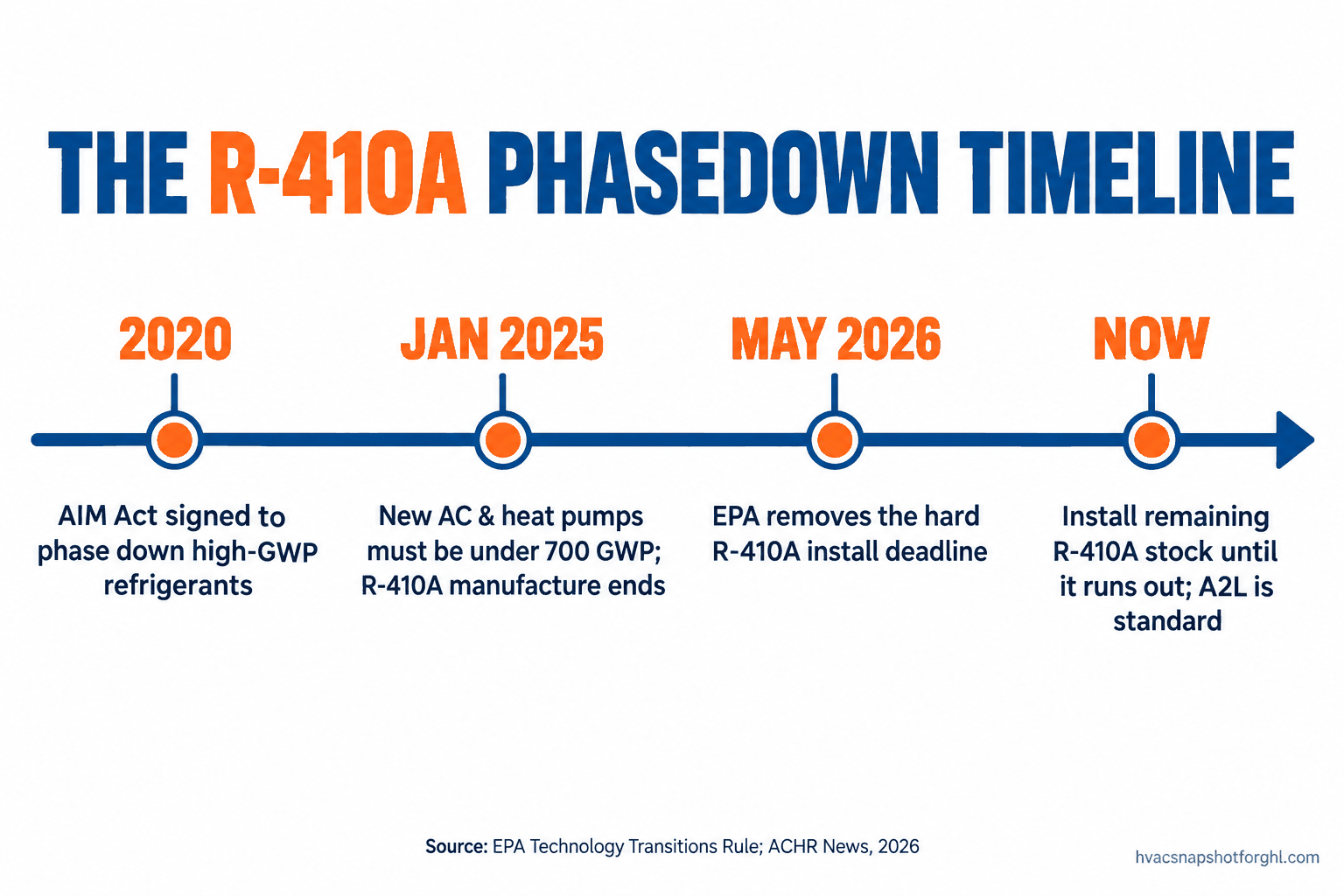
For fifteen years R-410A was the default in residential cooling. It is on the way out now not because of how it cools but because of its global warming potential (GWP), a measure of how much heat a gas traps compared to carbon dioxide. The lever is a 2020 law, the American Innovation and Manufacturing Act (AIM Act), which told the EPA to phase down high-GWP hydrofluorocarbons. Out of it came the Technology Transitions Rule, and the part that hits your driveway quote is simple: new residential and light-commercial AC and heat pump equipment made on or after January 1, 2025 must use a refrigerant with a GWP below 700. R-410A, at 2,088, misses that bar, so manufacturers moved to A2L blends.
The date people get wrong is the installation date. The manufacture cutoff is not a demolition order for the R-410A units already in a warehouse or on your truck. The original rule set a January 1, 2026 deadline to install that stock, but in May 2026 the EPA removed the hard install deadline entirely, so pre-2025 R-410A components can be installed until the inventory is depleted, with no cliff date (ACHR News, 2026). Through the changeover you live in two worlds: new A2L systems from the factory, and a shrinking pool of R-410A equipment you can still legally install. That stock is finite and its price is climbing, so treat it as a depleting asset, not a plan.
R-410A vs R-454B vs R-32, in plain terms
You do not need a chemistry lecture, just what changes when you handle it and what to say when a customer asks. Three numbers and one letter cover it.
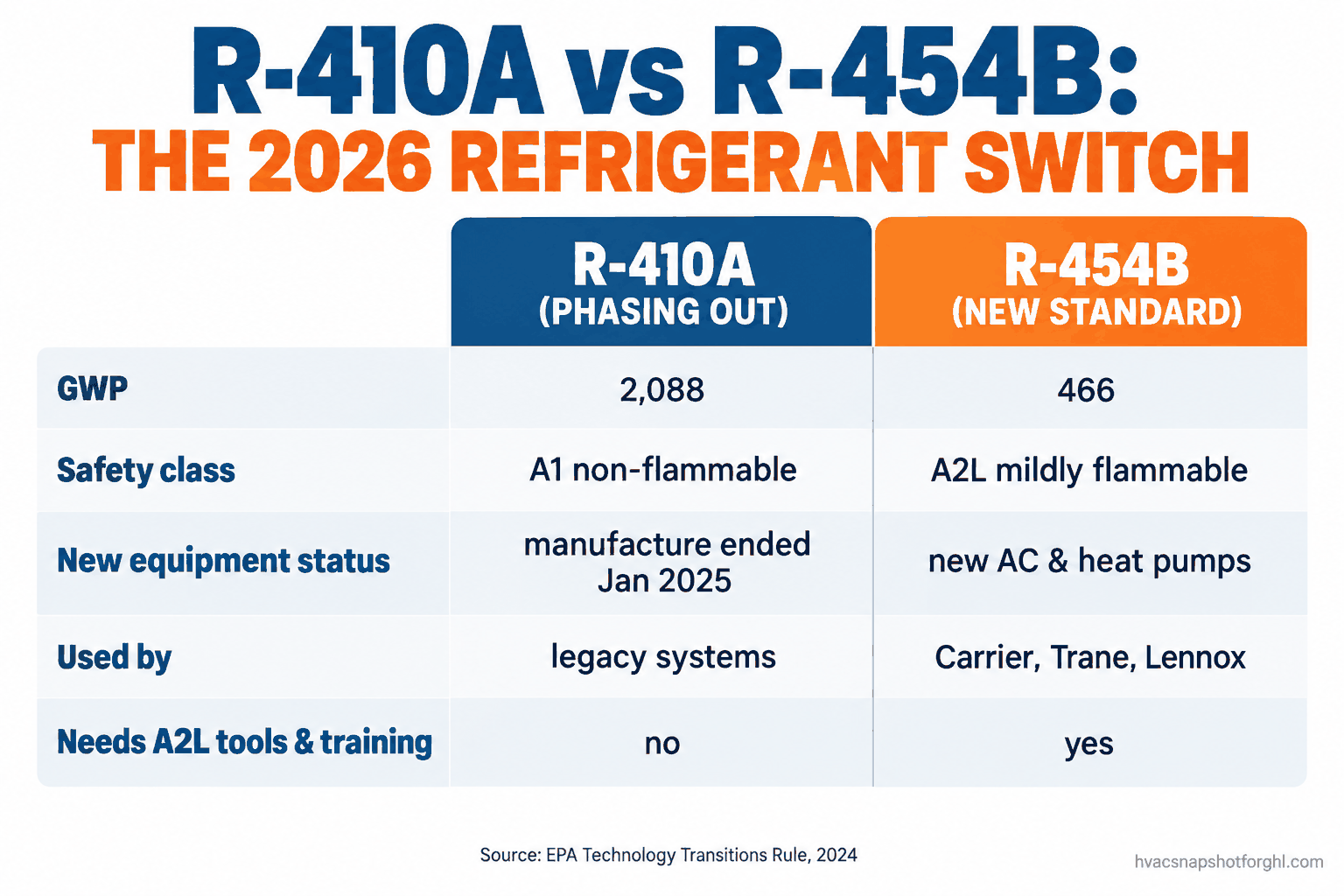
R-410A is what you know: safety class A1, no flame propagation, low toxicity. Its only problem is the GWP of 2,088, which is why it is being wound down, not because it is unsafe.
R-454B is the blend Carrier, Trane, Lennox and others chose for their new residential lineups. GWP around 466, roughly a 78% cut, and its performance is close enough to R-410A that system design barely changes.
R-32 is the single-component refrigerant Daikin and others adopted. GWP around 675, still under the limit, and slightly more efficient at moving heat (IWAE, R-32 vs R-454B).
The one letter that matters is the A2L safety classification both new refrigerants carry (AAON on A2L, 2025). The “2L” means mildly flammable with a low burning velocity. It is not propane and will not flash off a spark across a room, but it is a step up from R-410A’s A1 “no flame” rating. That is why new equipment ships with leak sensors, why your recovery and charging tools need to be A2L-rated, and why the training is not optional.
Why your equipment quotes keep moving
The homeowner thinks the price is the price. You know a quote is a picture of costs on the day you wrote it, and right now those costs will not sit still. Three forces push them.
First, R-410A itself got expensive fast. The AIM Act cuts how much high-GWP refrigerant can be produced and imported each year, with allowances down to roughly 60% of baseline from 2024 and stepping lower through the phasedown (EPA). Supply tightened while demand for repairs on millions of installed R-410A units did not, and industry reports put wholesale R-410A up anywhere from 40% to nearly double across 2024-2025 depending on the market (HVAC.com, 2026). A repair that leaned on an R-410A top-off is a different number than two summers ago, and still moving.
Second, the new A2L equipment carries a premium. Leak sensors, redesigned components, and the switchover cost all landed in the wholesale price, so a new-refrigerant system generally costs more than the R-410A unit it replaces. With the national average central AC replacement already around $5,860 (typical range $3,900 to $7,900, Angi, 2026), even a few hundred dollars of premium is a number the homeowner notices.
Third, you are quoting from shrinking inventories. A quote you gave Monday can be wrong by Friday because the R-410A box you priced sold out or the A2L line went short. That is the market mid-transition, not you being sloppy, which is why a written estimate needs an expiration date now.
The six things the switch changes in your shop
Here is what the switch lands on your operation, and how each part goes wrong.
1. What you can sell and install. You can still install pre-2025 R-410A stock alongside the new A2L lineup. Breaks when you quote an R-410A system your distributor can no longer source. Fix: keep one cheat-sheet of what your distributor has and what each option costs today.
2. Tools and shop stock. A2Ls need A2L-rated recovery machines, gauges, and leak detectors, and the two refrigerants are not interchangeable. Breaks when a truck rolls to an A2L job without rated tools. Fix: rate your gear and keep the two refrigerants separated and labeled on the truck.
3. Your quotes and pricing. Replacement tickets are bigger and less predictable. Breaks when you quote from last season’s numbers and lose the margin. Fix: re-price from live distributor cost, and date every equipment quote.
4. What you tell customers. Homeowners have heard “freon is banned” and “the new stuff is flammable” and are primed to be scared. Breaks when a tech improvises or talks the customer into stalling. Fix: give every tech the same short script, below.
5. Your ads and marketing claims. “Beat the refrigerant price increase” is a fair hook. “R-410A is illegal now” is not, and neither is a guaranteed rebate amount. Breaks when a claim crosses into false urgency, which is a trust problem and, for texts, a TCPA and consent problem. Fix: keep urgency truthful and rebate figures illustrative.
6. Warranty and parts on the installed base. Millions of R-410A units are still under warranty and will need service for a decade. Breaks when you assume R-410A parts vanish overnight and mishandle a repair-versus-replace call. Fix: R-410A service continues; plan for pricier refrigerant, not its disappearance.
Where EPA 608 fits now
None of this changes the credential that governs handling refrigerant. Under Section 608 of the Clean Air Act, anyone who buys or handles regulated refrigerant needs EPA 608 certification (EPA), and that includes the new A2L blends. The four certification types have not changed:
- Type I for small appliances.
- Type II for high-pressure appliances, which is most residential AC and heat pump work.
- Type III for low-pressure appliances.
- Universal for all three.
Two things for your crew. EPA 608 does not expire, so a tech certified years ago is still certified. But 608 is not the same as A2L safety training, the separate manufacturer training your techs need before touching the new equipment: 608 lets you buy the refrigerant, the A2L training keeps the job safe. It also belongs in your marketing, because “EPA 608 certified, A2L trained” on your booking page is a trust signal the roll-up across town may not spell out.
Three shops, three ways this lands
The switch is the same rule for everyone, but the right response depends on your size.
The solo operator (owner plus a helper). Your risk is inventory and cash, not process. You cannot stock deep, so you are exposed to the week-to-week swing in R-410A price and A2L availability. Quote from live cost, date every estimate at 14 days, and lean on your distributor rep for a heads-up before a line goes short. Your edge is speed: you explain the change one-to-one better than any call center, so make sure the phone gets answered and quotes go out same day, because a missed call quietly becomes a lost install.
The 5-tech shop. Now the problem is consistency across trucks. Five techs improvising five answers to “is the new stuff dangerous?” costs sales and creates liability. Standardize one refrigerant script, one quote template with the expiration line built in, and one A2L-training schedule for the whole crew. This is the size where a shared CRM and automated follow-up stops quotes going stale in an inbox.
The 12-tech shop. Volume gives you buying power and a warehouse that cushions the price swing, but also the most exposure to a compliance slip across a bigger crew. Your job is systems: a training log that proves every tech touching A2L is trained, and pricing that updates from live cost, not a laminated card three months old. At your scale this is a margin-management problem, and the winners treat it like one.
Steal this: what to tell the customer
This is the part that saves the sale. Homeowners want to know three things: is their system affected, is the new stuff safe, and why does it cost more. Give your techs these word for word and stop the improvising.
The 20-second explainer (say this on the driveway):
“Quick heads-up on the equipment. The government is phasing out the old refrigerant, R-410A, because it is hard on the environment, and switching new systems to a cleaner one. It cools your home exactly the same. Two things for you: new systems cost a bit more than a couple of years ago, and the old refrigerant for repairs is getting pricey. So I will lay out repair-versus-replace with real numbers and let you decide.”
The “is it flammable?” answer (say it calmly):
“Good question. The new refrigerant is rated mildly flammable, which sounds scarier than it is. It is nothing like propane or natural gas. The equipment is built for it, with a leak sensor inside, and it is the same refrigerant every major manufacturer is now using. It is safe in your home.”
The equipment-quote line (put it in writing on every estimate):
“This quote reflects today’s equipment and refrigerant pricing and is valid for 14 days. Because the industry is mid-transition to new refrigerants, equipment cost and availability are changing month to month, so quotes past 14 days may need a quick update.”
The follow-up text (automated, TCPA-compliant, only to opted-in contacts):
“Hi [Name], it’s [Shop]. Your AC replacement quote from [date] is good through [date+14]. Prices on the new-refrigerant systems are moving this season, so reply YES to lock this one in or call [number] with questions. Reply STOP to opt out.”
That last one only goes to homeowners who opted in to texts and carries a clear opt-out, because a replacement quote is a marketing text and the 10DLC and TCPA rules apply. Homeowners will also ask about rebates: point them at the IRA 25C tax credit path, keep the figure illustrative, and when sticker shock hits, financing reframes a bigger quote as a monthly number that closes more jobs than any discount.
Objections and honest answers
“Can I still sell and install R-410A units?” Yes. The manufacture cutoff was January 1, 2025, and the EPA removed the hard install deadline in May 2026, so you can install pre-2025 R-410A stock until it runs out (ACHR News, 2026). The pool is shrinking and prices are rising, so treat it as a depleting asset, not a long-term plan.
“Do I need to re-certify my techs?” Not for EPA 608, which does not expire. But 608 and A2L safety training are two different things, and your techs need the A2L training on top of their 608 before working on the new systems. Budget the time now rather than scrambling at the first A2L warranty call. The refrigerant is not the danger; sending an untrained tech with the wrong recovery machine is.
“Won’t higher equipment prices kill my close rate?” Only if you let the number land cold. The shops holding their close rates explain the change in plain language, date their quotes, follow up fast, and offer financing so the homeowner hears a monthly payment, not a sticker. The change raised everyone’s prices, not just yours, so the differentiator is how clearly you handle the conversation.
The bottom line
The refrigerant change is not a threat to your business, but it permanently changes how you quote and how you talk to customers. New systems use A2L refrigerants like R-454B and R-32, they cost more, and the old R-410A stock is getting scarce and pricey. Date your quotes, train your crew, and give every tech the same honest script. The shop that turns a confusing rule change into a calm conversation keeps writing tickets while everyone else argues about “freon.”
Frequently asked questions
R-454B and the refrigerant change: common questions
Is R-410A banned in 2026?
Not exactly. Under the EPA Technology Transitions Rule and the AIM Act, new residential AC and heat pump equipment manufactured on or after January 1, 2025 must use a refrigerant with a GWP under 700, which R-410A (GWP 2,088) exceeds. But R-410A itself is not illegal to use or service, and the EPA removed the hard install deadline in May 2026, so you may install pre-2025 R-410A stock until supplies run out. Existing R-410A systems can be serviced for years.
What is R-454B and how is it different from R-410A?
R-454B is a lower-GWP refrigerant blend adopted by Carrier, Trane, Lennox and others for their new residential lineups. Its GWP is around 466 versus 2,088 for R-410A, roughly a 78% reduction. It cools comparably, but it carries an A2L (mildly flammable) rating instead of R-410A's A1, so it needs A2L-rated tools, leak sensors, and A2L safety training for technicians.
Is R-454B dangerous or flammable?
R-454B is classified A2L: mildly flammable with a low burning velocity. It is a step up from R-410A's non-flammable A1 rating but nothing like a fuel gas such as propane. New equipment is engineered for it with built-in leak detection and is safe in the home. Technicians need A2L training and A2L-rated equipment to work on it safely.
Do I still need EPA 608 certification for R-454B?
Yes. EPA Section 608 certification is required to buy and handle regulated refrigerants, including A2L blends like R-454B and R-32. The four types (Type I, II, III, and Universal) are unchanged, and 608 does not expire. Note that 608 is separate from A2L safety training, which technicians also need before working on the new systems.
Why did my AC replacement quote go up?
Two reasons stacked. New A2L equipment costs more than the R-410A units it replaces, and R-410A refrigerant prices climbed sharply through 2024 and 2025 as production was phased down, making repairs on older systems pricier too. Because both are still moving, reputable shops now put a 14 to 30 day expiration date on equipment quotes.
R-454B or R-32, which is better?
Both are compliant and good. R-454B (GWP around 466) is used by Carrier, Trane and Lennox; R-32 (GWP around 675) is used by Daikin and others and is slightly more efficient at moving heat. For most residential shops the choice follows the equipment brand you already sell rather than the refrigerant itself, and both need A2L handling.
About the author
Tom Becker is a Home-Services Marketing and Compliance Writer based in Minneapolis, MN. He covers the demand-generation and regulatory side of running an HVAC shop, from seasonal tune-up campaigns and rebate funnels to the SMS and refrigerant rules that shape what contractors can say and sell. He translates dense topics like the AIM Act, EPA 608, and TCPA into checklists owners can act on.
Related posts
- 10DLC + TCPA for HVAC Contractors: A Plain-English Guide
- IRA 25C Rebates: Turning Tax Credits Into Closed Tickets
- HVAC Financing: How Payment Plans Close More Replacement Jobs
- Why After-Hours Missed Calls Are Costing You Installs
- What HVAC Software Really Costs in 2026: A Small-Shop Pricing Teardown