
It’s Thursday morning and you’re looking at the open-quotes list on your phone in the truck. Fourteen estimates sitting there. Not tire-kickers, real ones: a compressor that let go on Tuesday, a 19-year-old furnace one of your guys red-tagged last week, a heat pump swap somebody asked for on Monday. Add them up and it’s north of $130,000 in work you’ve already paid to earn, quotes your techs already drove out and wrote. And every single one is stuck on the same status: sent, no reply.
Here’s the part that stings. Most of those homeowners are not gone. They’re comparing you against two other shops, waiting on a spouse, or doing quiet math on a number they don’t have sitting in the bank. The job is still winnable. It just needs someone to reach back out at the right time with the right message, and on a busy shop that person does not exist. The quote goes cold, and three weeks later you hear the neighbor’s guy did the install.
That’s the leak this piece is about. Not the calls you miss (we covered after-hours missed calls and speed to lead separately), but the warm replacement quotes that stall out after the estimate and die from silence. It’s the most expensive leak in the shop because the lead is already bought and the tech time is already spent. And it’s the cheapest to plug, because the fix is a follow-up system that runs itself.
On this page
- What is an HVAC quote follow-up system?
- What a stalled quote actually costs you
- Why replacement quotes go quiet
- The 6-stage HVAC quote follow-up system
- The steal-this message pack
- Run it for three different shops
- Staying legal: TCPA and 10DLC
- Objections, answered straight
- Frequently asked questions
What is an HVAC quote follow-up system?
An HVAC quote follow-up system is the fixed sequence of touches - text, email, and one live call - that you send a homeowner automatically after you hand them a repair or replacement estimate, spaced over about 30 days, designed to answer the reason they went quiet and book the job while their intent is still warm. It is not “circle back when you remember.” It is a scheduled cadence that fires on its own the moment a quote is marked sent, and stops the second the homeowner books, says no, or opts out.
The difference matters because memory does not scale. On a good week a five-truck shop writes twenty to forty estimates, and nobody hand-tracks forty follow-ups on the right days without dropping half of them. So the quotes that get chased are the big ones the owner happened to remember, and the rest rot. A system fixes that by treating every quote the way a dispatch board treats every call: a status, a timer, and a next action, so nothing falls off just because Tuesday got busy.
It runs three jobs at once. It confirms and recaps while the tech’s visit is still fresh. It works the real objection - almost always price, payment, or a second opinion - before the homeowner commits to a competitor. And it keeps you top of mind through the deciding window without you lifting a finger. Do those three things on a schedule and your close rate on quotes you already wrote goes up, with zero new ad spend and zero new trucks.
What a stalled quote actually costs you
Run the math on your own board and it gets uncomfortable fast. Say you write 30 replacement quotes a month at an average of $8,000, so $240,000 in written work. Close 30% and you book $72,000. Nudge that to 40% - the kind of lift a real follow-up cadence delivers - and you book $96,000 off the exact same quotes. That’s $24,000 a month left on the table, not because your pricing was wrong or your techs were slow, but because nobody reached back out.
The persistence gap is the whole game. Roughly 80% of sales require an average of five follow-up touches after the first contact, but 48% of salespeople never follow up at all and 44% give up after one attempt (Invesp). In this trade it’s worse, because the “salesperson” is usually a tech who wants to be turning wrenches, not chasing a proposal. Simply showing up a fourth and fifth time puts you ahead of a field where most players quit after the first.
Speed still counts on the first touch. A homeowner who just watched a tech pull the panel is at peak trust and peak worry; wait two days to recap and that moment is gone. The classic Harvard Business Review study found that contacting a lead within the first hour made a firm about seven times more likely to have a meaningful conversation. The recap that lands before the truck leaves the driveway does more work than the one that lands Friday.
Why replacement quotes go quiet
You cannot write follow-up copy that works until you know what you’re answering. In residential HVAC, a stalled replacement quote almost always went silent for one of three reasons, and none of them is “your price was too high.”
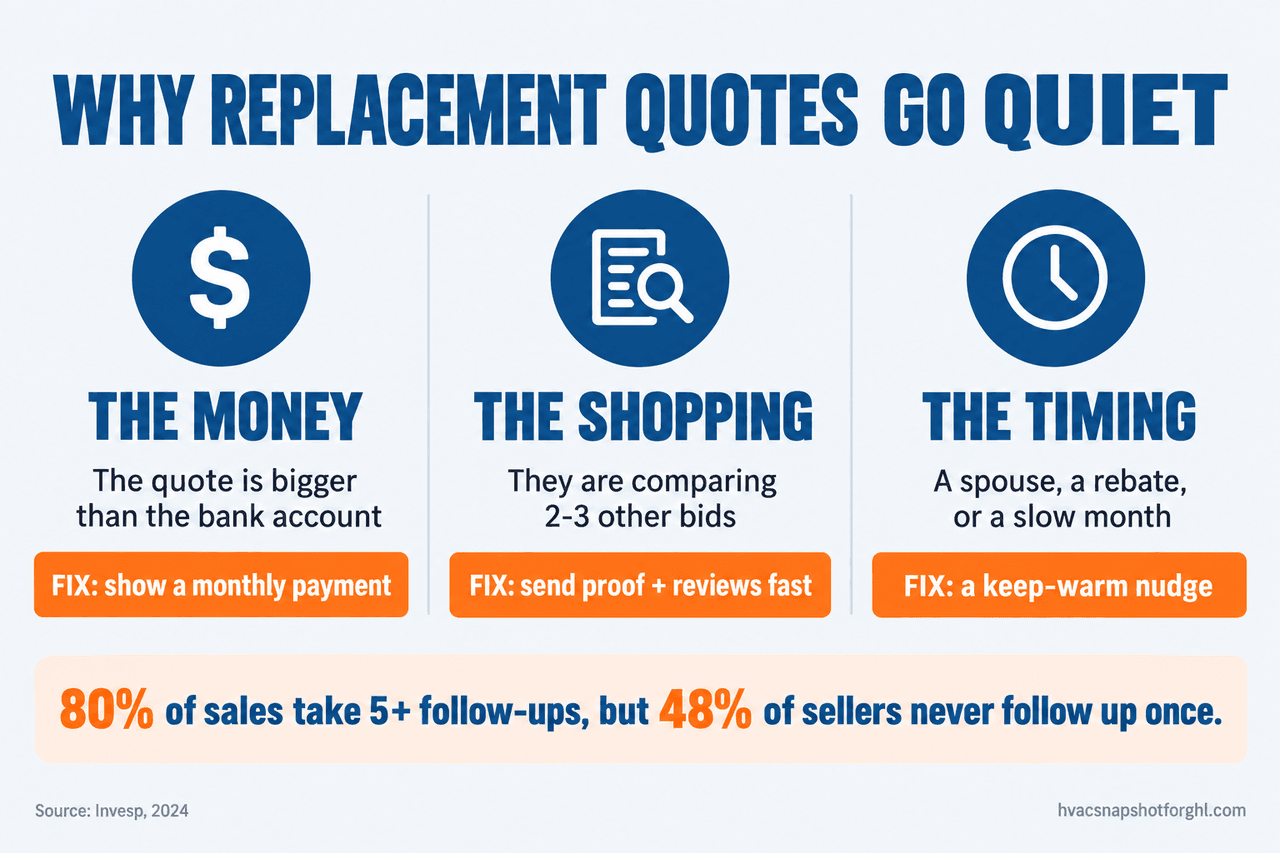
Reason one: the number is bigger than the bank account. A full system replacement averages about $7,500 and routinely runs $10,000 or more on a high-efficiency, two-stage, or heat pump changeout (Angi). Meanwhile only 48% of U.S. adults could cover a $2,000 expense from savings, and more than half can’t absorb $2,000, let alone $8,000 (Federal Reserve, 2024 SHED). Bankrate’s 2025 survey found 59% of Americans couldn’t cover a surprise $1,000 bill. The homeowner nodding at your quote usually can’t pay it from checking and won’t say so. Silence is the polite version of “I need this to feel affordable.” That’s a financing and payment-framing problem, not a discount problem.
Reason two: they’re getting other bids. Most homeowners shop a replacement. A survey of homeowners found about two-thirds gather three quotes before choosing an HVAC contractor (ACHR News), and while not everyone follows through, plenty do. Your quote is sitting in a stack next to two others, and the shop that stays in front of them through the deciding window is the one that gets picked - often not the cheapest, just the one that felt the most on-the-ball.
Reason three: life got in the way. A spouse wasn’t home. The AC limped back to life so the panic faded. They’re waiting on a tax refund, a rebate answer, or a slower month. None of that is a no. It’s a “not this week,” and a not-this-week that nobody nurtures becomes a competitor’s install by next season.
The 6-stage HVAC quote follow-up system
Here’s the cadence. Six touches over about 30 days, each with a job, real copy you can steal, the timing that works, and - the part nobody else writes down - how it breaks and what to do about it. Every touch stops the instant the homeowner books or opts out.
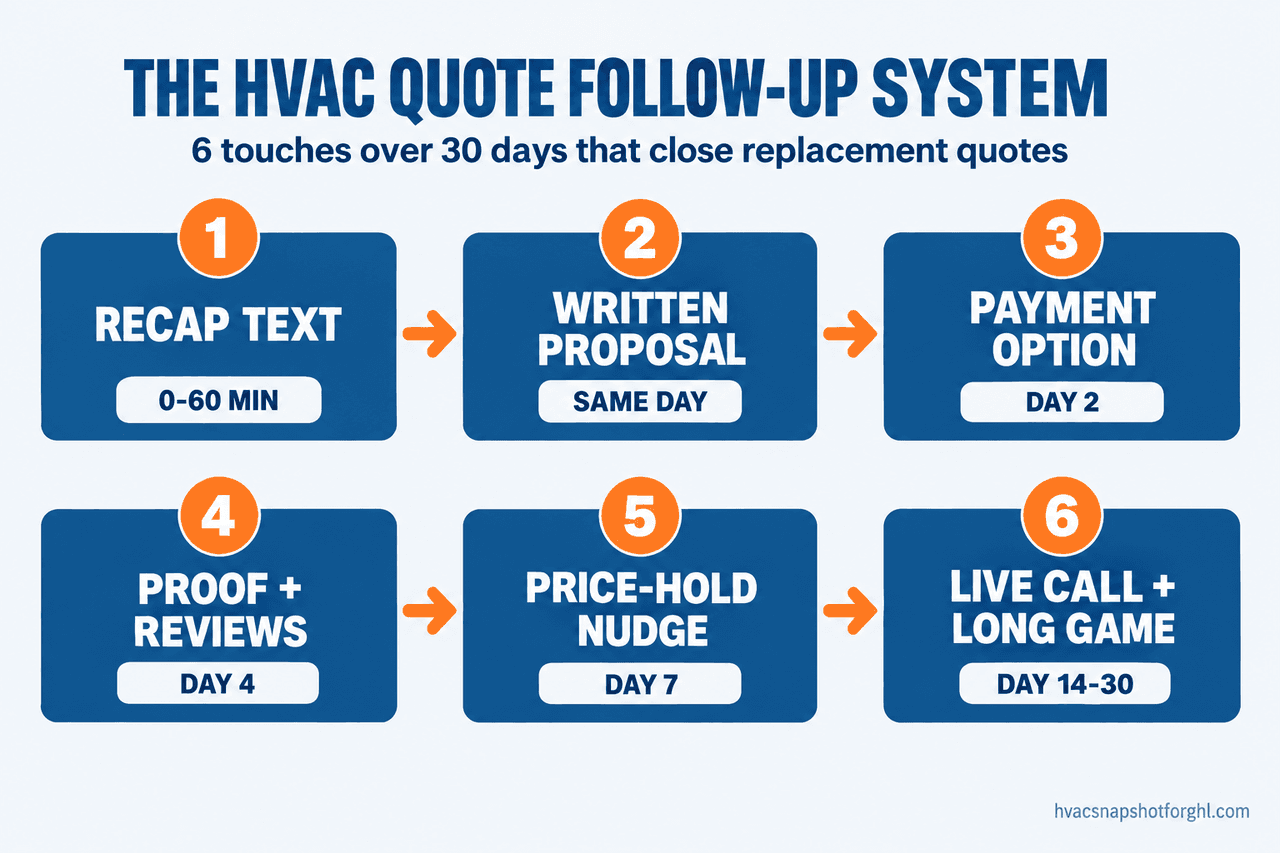
Stage 1: The recap text, before the truck leaves the driveway (0-60 minutes)
The job here is to lock in the moment of peak trust. Your tech is still the expert who just diagnosed the problem in the homeowner’s living room. The recap text confirms the number, restates the fix in plain language, and drops a link to the written proposal. It also, quietly, captures the mobile number and text consent you’ll need for everything after.
The copy:
Hi Linda, it’s Marcus with Ace Comfort. Great meeting you today. Quick recap: your 18-yr-old system is leaking refrigerant at the coil, and the smart move is a full replacement rather than a repair that won’t hold. Your written quote for the 16 SEER2 system is $8,400, and I’ve sent it to your email. Any questions, just text me right here. - Marcus
How it breaks: the tech forgets, or types it from memory at a red light and gets the number wrong. Fix it by making the recap fire automatically the moment the quote is marked “sent,” pre-filled with the customer’s name, the system, and the price. The tech taps send, or it goes on its own. No memory required.
Stage 2: The written proposal with options, same day (within a few hours)
A number texted in a hurry is not a proposal. The homeowner needs something they can forward to a spouse and sit with: the real quote with good/better/best options, the warranty, financing pre-framed as a monthly figure, and a photo or two from the visit. Two things matter. Show the monthly payment next to the cash price, because “$142/mo” changes the weight of “$8,400” completely. And give three tiers, because a homeowner deciding between your options is no longer deciding whether to use you.
How it breaks: it goes out as a bare PDF with one line-item total and no payment option, so the homeowner opens it, sees a five-figure number with no bridge, and closes it. Fix it with a proposal template that always shows the monthly figure and always shows tiers, so no tech has to remember to build it.
Stage 3: The “make the number feel possible” touch (Day 2)
Now you answer the money objection head-on, before it hardens into a no. Short text, one idea: you don’t have to pay for this all at once. Contractors who offer financing close 49% of quotes versus 38% for those who don’t (ACHR News / Clear Seas Research), and Wisetack’s data shows home-services jobs paid with financing run about 4.5x larger. The financing deep-dive covers how to wire this in.
The copy:
Hi Linda, Marcus here. Wanted to make sure you saw the payment option on your quote - the 16 SEER2 system works out to about $142/mo with approved credit, and applying takes about 2 minutes on your phone with no hit to your score to check. Happy to walk you through it or answer anything. Here’s the link: [apply]
How it breaks: you send this to a “shopping” or “timing” homeowner who was never worried about money, and it reads like you’re pushing debt. Fix it with the tag from earlier - the money message only fires for quotes tagged money. A shopping homeowner gets the proof touch instead.
Stage 4: The proof touch (Day 4)
Silence in the shopping window is usually doubt, not disinterest. This touch removes it with proof, not pressure: a recent review from a nearby customer, your license and warranty, a photo of a clean install. You’re answering the question they’re asking two other shops - “will these people do it right and stand behind it?” It’s the natural place to point them at your Google reviews, which sell harder than any line of copy you’ll write.
The copy:
Hi Linda, no rush at all - just wanted you to have this. We installed the same system for the Hendersons over on Maple last month; here’s what they said [review link]. Every install comes with our 10-year parts warranty and a workmanship guarantee in writing. Whenever you’re ready, we’ve got you. - Marcus
How it breaks: it turns into a hard “are you ready to book?” push that makes a hesitant buyer defensive. Keep it proof-first and pressure-free. The ask is implicit; the proof does the work.
Stage 5: The deadline touch (Day 7)
A real, honest deadline breaks a stall. Not a fake “prices go up Friday” gimmick - homeowners smell those. Use the deadlines that are actually real in this trade: a quoted price you’ll hold for 30 days, a manufacturer rebate window, a seasonal install-slot crunch, or the refrigerant transition that’s genuinely moving equipment pricing as the industry shifts to R-454B. Pick the one that’s true for this quote and say it plainly.
The copy:
Hi Linda, quick heads up - I locked your $8,400 pricing in when I quoted it, and I can hold that number through the end of the month. After that I’d have to requote at current equipment cost, which has been creeping up with the refrigerant changeover. Want me to get you on the install schedule while the price holds?
How it breaks: you invent urgency that isn’t real, the homeowner calls a competitor who quotes the same system with no deadline pressure, and now you look like the pushy one. Only ever cite a deadline that’s actually true. If none is, skip this touch and go straight to the long game.
Stage 6: The long game (Day 14 to 30, then seasonal)
Most quotes that don’t book in the first week aren’t dead - they’re parked. This stage keeps you warm through a decision that might take a season, plus one deliberate “break glass” move: a live call. Automation books the easy yeses; a human call recovers the ones that need a real conversation. On Day 10 to 14, a task drops on someone’s board to actually dial. Then the quote shifts into a low-frequency nurture: a check-in text around Day 21, and after that a seasonal touch when the weather turns, because the furnace they didn’t replace in September becomes urgent the first hard freeze.
The copy (Day 21 check-in):
Hi Linda, Marcus with Ace Comfort. Just keeping your quote handy in case now’s a better time - it’s still good and I can get you scheduled quickly. If you’ve gone another direction, no worries at all, just let me know and I’ll stop the reminders. Either way, we’re here when you need us.
How it breaks: the sequence never ends, so a homeowner who bought elsewhere keeps getting texts and gets annoyed enough to leave a bad review. Fix it with a clean exit in every message and a hard stop at 30 days into a quarterly seasonal list. Persistence is not harassment; the difference is an easy off-ramp and a sane frequency.
The steal-this message pack
Everything above, in one place, so you can drop it into your CRM today. Swap the names and numbers for yours.
Notice what the pack is not: seven identical “just checking in” texts. Each touch answers a specific reason the quote stalled, in the order those reasons tend to surface - confirm, clarify, fund, prove, decide, park. That’s why it beats a tech’s memory. The tech, at best, sends “you still interested?” once, three weeks late, to everyone.
Run it for three different shops
The framework is the same; the way you staff and tune it changes with the size of the shop. Here’s how the exact same cadence plays out across a solo operator, a five-truck shop, and a twelve-truck outfit.
| Solo / 1-2 trucks | 5-truck shop | 12-truck shop | |
|---|---|---|---|
| Who owns follow-up | You, from the truck | Office manager + automation | Dedicated CSR / sales coordinator |
| Biggest risk | You forget entirely | Quotes fall between techs | Leads lost in volume, no accountability |
| What to automate first | Touches 1, 3, 5 | The whole cadence + tags | Cadence + routing + reporting |
| The live call (Touch 6) | You, batched Friday | Office manager | Coordinator, tracked on a board |
| Win to expect | Stop losing quotes to silence | +5-10 pts close rate | Recovered revenue you can measure |
Solo operator. You are the office, so follow-up competes with paying work and loses. Automate the touches that don’t need judgment - recap, payment, deadline - so they fire without you, and batch your live calls into one Friday block. Even a half-built version beats what you’re doing now, which is nothing after the quote leaves the driveway.
Five-truck shop. Here the problem is hand-offs: a tech writes the quote, the office is supposed to chase it, and the two never sync. Put every sent quote on a shared board with a status, let automation carry the routine touches, and free your office manager for the one call that matters. This is the size where a real cadence moves the close rate five to ten points.
Twelve-truck shop. At this volume quotes get lost in sheer count and nobody owns any single one. You need routing, reporting on how many stalled quotes you recovered this month, and a coordinator whose whole job is the board. Automation is non-negotiable - no human tracks 150 open quotes by hand - but now the recovery is a number you can put on a dashboard and manage.
Staying legal: TCPA and 10DLC
Texting a homeowner about the quote they asked for is about as safe as SMS marketing gets, but the rules still bind you and getting them wrong is expensive. Two things to keep straight.
First, TCPA and consent. The Telephone Consumer Protection Act governs texting, and the safe path is simple: get express consent, keep a record of it, honor opt-outs instantly. When Linda hands your tech her number and agrees to text updates about her quote, that’s your consent - log it with a timestamp. Every message needs an easy opt-out, and a STOP has to actually stop the sequence. Our deeper TCPA and 10DLC guide for HVAC walks the full checklist.
Second, A2P 10DLC registration. To send business texts from a regular 10-digit number, carriers require you to register your brand and campaign. Illustrative 2026 costs: a one-time brand registration around $4.50, campaign vetting near $40-$50, a recurring campaign fee commonly $2 to $10 per month, and a carrier surcharge of roughly $0.003 to $0.005 per message (GoHighLevel A2P fee schedule). Pennies against a $24,000-a-month revenue swing - but skip registration and your texts get filtered or blocked, which quietly kills the whole system.
Objections, answered straight
“Won’t all these texts annoy people and make me look desperate?” Only if you spray generic “you still interested?” messages at everyone. A tagged sequence that answers the actual reason someone stalled, spaced sanely, with a one-tap opt-out, reads as attentive, not pushy. Remember the baseline you’re compared against: 48% of your competitors follow up zero times (Invesp). Showing up a fourth time, helpfully, is not desperation. It’s the reason you got picked.
“I already pay for ServiceTitan / Housecall Pro - doesn’t it do this?” Those platforms store the quote and, on the right tier, fire some reminders. What they don’t do out of the box is a tagged, objection-specific cadence that branches on why the quote stalled, pre-frames financing as a monthly number, routes a live-call task, and exits cleanly on opt-out. Most shops have the capability sitting unused because nobody built the sequence. If you’re weighing what you pay for all this, our HVAC software pricing teardown and ServiceTitan alternatives breakdowns lay out the real numbers.
“Do I need to be technical to set this up?” No, but somebody has to build it once, and that’s the honest catch. The logic - tags, timing, branch on objection, stop on book - is straightforward, but wiring it inside a CRM takes a few focused hours if you know the tool, or it comes pre-built. That’s the entire reason done-for-you systems exist: the sequence is already assembled, and you’re just plugging in your name, numbers, and financing link.
“My tickets aren’t $10k - most of my work is repairs.” Then run a lighter version. The full six-touch cadence earns its keep on replacement quotes, but even a three-touch version on repair estimates - recap, proof, one nudge - recovers work you’re currently losing to silence. The dollars per quote are smaller, but you write far more of them, and the same automation handles both without extra effort.
Frequently asked questions
How many times should I follow up on an HVAC quote?
Plan for about six touches over 30 days. Roughly 80% of sales take an average of five follow-ups to close, yet most sellers stop after one, so persistence is a genuine edge. Space the touches, vary the message to answer the real objection, and stop the moment the homeowner books or opts out.
How soon after the estimate should I follow up?
Within the hour. The recap text should go out before the truck leaves the driveway, while the homeowner is still at peak trust. Studies of lead response show reaching out within an hour makes you several times more likely to move the deal forward, and the same principle applies to a fresh quote.
What's the best way to follow up on a quote - call, text, or email?
Lead with text, back it with email, and use one live call for the ones that stall. SMS runs about a 98% open rate with most messages read within three minutes, so it's the fastest way to catch a deciding homeowner. Email carries the full written proposal, and a human call recovers the deals that need a real conversation.
Is it legal to text customers follow-ups about their quote?
Yes, when you have express consent and follow the rules. Under the TCPA you need consent (which the homeowner gives when they hand over their number for quote updates), a logged record of it, and a working opt-out in every message. You also need to register your number for A2P 10DLC so carriers deliver your texts.
How long should I keep following up before I give up?
Run the active cadence for about 30 days, then move the quote to a low-frequency seasonal list rather than dropping it. A furnace someone didn't replace in September becomes urgent at the first freeze, so a light seasonal touch keeps you top of mind without becoming annoying.
Doesn't following up this much make me look desperate?
Not if each message is helpful and easy to opt out of. Desperation is seven identical 'you still interested?' texts. A sequence that answers the homeowner's actual concern - price, proof, or timing - and gives a one-tap exit reads as attentive. Meanwhile nearly half your competitors follow up zero times, so showing up at all sets you apart.
Can't my field-service software already do this?
Partly. Most platforms can store the quote and send basic reminders, but few do a tagged, objection-branched cadence with financing framing and clean opt-outs out of the box. The capability often exists unused because nobody built the sequence - which is exactly what a pre-built system solves.
It’s Thursday morning again, and you’re back at that open-quotes list. Except now every one of those fourteen quotes has a status and a next touch already scheduled. Linda’s $8,400 job got a recap before the truck left, a payment option on Day 2, a neighbor’s review on Day 4, and a price-hold nudge on Day 7 - none of which you had to remember to send. She books on Day 8, and you find out from a notification while you’re on a roof. That’s not a bigger sales team or a bigger ad budget. It’s the same quotes you were already writing, finally worked to the end. The only question is whether anything reaches back out before they go cold.