
You noticed the van first. New wrap, a name you half-recognize, parked on a street you’ve worked for fifteen years. Then you Google your own service area from the truck and there they are: three ad slots, the top of the map pack, more reviews than you’ve collected in a decade. Same trucks you saw last summer under different names, now flying one flag. That’s a roll-up. A private-equity fund bought four or five shops in your metro, bolted them together, and pointed a marketing budget at your customers that you cannot match dollar for dollar.
Here’s the part that should make you feel better. You’re not losing to a better contractor, your techs are as good or better. You’re losing to a better funnel. The roll-up wins the homeowner in the six steps before anyone turns a wrench, and each one is fixable this month for a fraction of what the fund spends.
On this page
- What is an HVAC roll-up, and why does it beat you?
- What the roll-up actually costs a small shop
- The homeowner’s path: six places you lose the job
- The steal-this message pack
- Run the play for three different shops
- Staying legal: TCPA and 10DLC
- Objections, answered straight
- Frequently asked questions
What is an HVAC roll-up, and why does it beat you?
An HVAC roll-up is a private-equity-backed company that buys several independent contractors in one region, keeps their trucks running, and merges the back office, branding, and marketing into a single machine. The fund spreads one big ad budget, one call center, and one CRM across a dozen former mom-and-pops, then uses the combined volume to dominate search and reviews in every zip code at once.
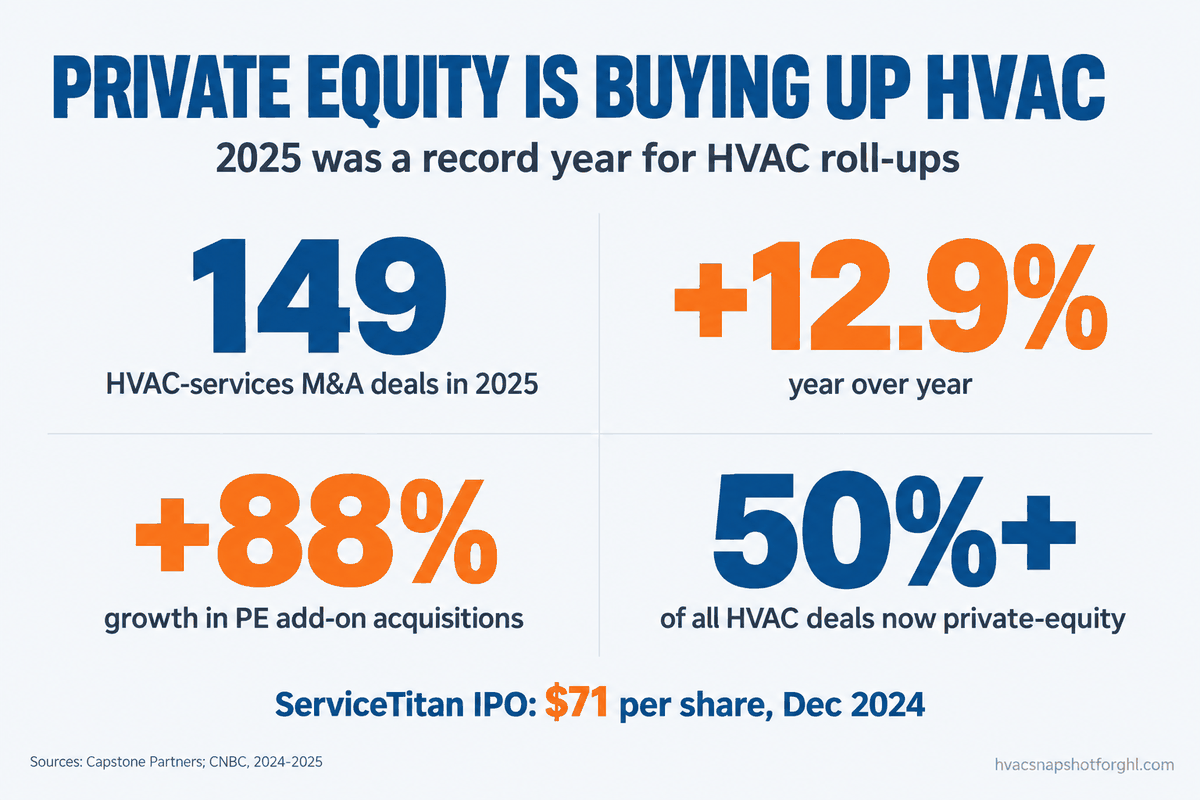
The 2025 numbers are blunt: 149 HVAC-services M&A transactions, up 12.9% over the prior year, with financial buyers now roughly half of all HVAC dealmaking (Capstone Partners). PE add-on deals grew 88% year over year, and one platform alone, Apex Service Partners, made about 60 add-ons in 2025. Even the software these shops run got a war chest: ServiceTitan went public in December 2024 at a $71 IPO price, popping 42% on day one (CNBC).
So why does it keep winning your jobs? It competes where you’re weakest: it answers at 9pm when yours goes to voicemail, it ranks first because it has 900 reviews and you have 60, and it texts back in ten seconds because a system does it, not a person. None of those are craft advantages. They’re process, and process is what a focused small shop can copy.
What the roll-up actually costs a small shop
Put a number on it. Your average job runs a few hundred dollars on a repair and north of $7,500 on a replacement (Angi puts full HVAC replacement at $5,000 to $22,000, averaging about $7,500). Say the roll-up siphons three jobs a week out of your area, the ones that used to be yours by default. Two repairs and a replacement is easily $8,000 to $9,000 lost most weeks, all year. That’s not a pricing or quality problem, it’s a capture problem.
The twist: you’re probably already paying to generate a chunk of those lost jobs. Your ads and your site create the lead; it just leaks out before it becomes a booked ticket, and the roll-up stands at every leak point with a bucket. We mapped the internal version in the HVAC lead leak audit.
The homeowner’s path: six places you lose the job
Follow one homeowner from the moment her AC quits to the moment she pays. Six steps, and the roll-up has an edge at each. For every one: what the roll-up does, the counter-move, and how it breaks.
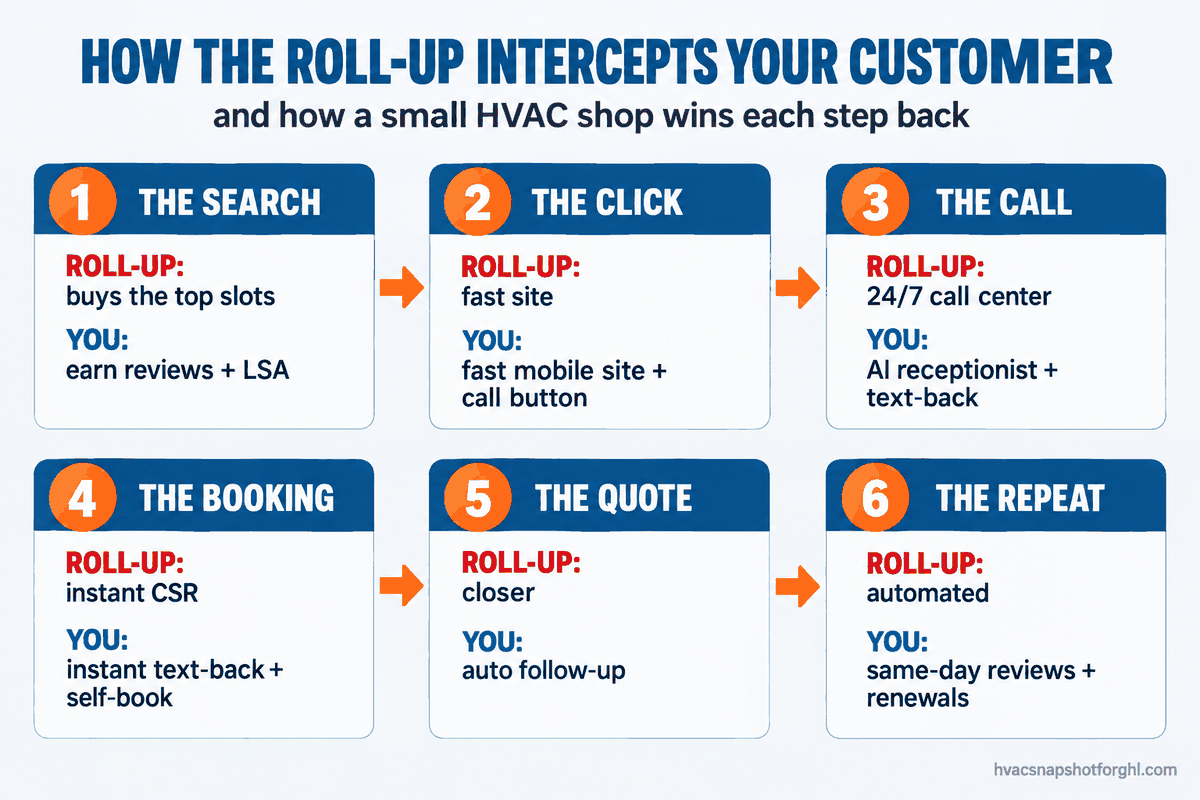
Stage 1: The search (they buy the top of the page)
She types “AC repair near me.” The roll-up owns the paid slots and the map pack, because it has thousands of reviews pooled across its brands. You can’t outbid a fund on clicks, but you can out-earn it on what moves the map pack: review volume and proximity. Get relentless about reviews (Stage 6), keep your Google Business Profile complete and category-correct, and lean on Local Services Ads, where you pay per lead and the screened badge sits above regular ads. HVAC search cost per lead averaged about $45 in 2025 (LocaliQ).
How it breaks: you chase rankings and ignore reviews, so the roll-up’s review lead compounds while you climb slowly. Fix Stage 6 first.
Stage 2: The click (their site loads, yours stalls)
She taps a result. The roll-up’s site loads in a second with a giant call button and an obvious “book online” path. If yours takes five seconds on a phone in a hot driveway, she’s back tapping the next name. Speed and one clear action are the whole job of a service site. The counter-move: a lightweight, mobile-first website with a thumb-sized call button pinned at the top and a booking widget for people who’d rather tap than talk.
How it breaks: you bolt on a chat pop-up, a video background, and tracking scripts, and the page crawls. Keep it fast and the call button impossible to miss.
Stage 3: The phone call (their call center answers, your phone rings out)
This is the big one. She calls. The roll-up’s call center picks up on the second ring, any hour. Your line rings out to voicemail, so she hangs up and calls the next name. You’ll never staff a 24/7 call center on a 5-truck P&L, and you don’t have to. An AI receptionist answers every call in your shop’s name, books onto the calendar, and texts you the details, for a rounding error against a call-center payroll. Pair it with missed-call text-back so any call you can’t take gets an instant text, not silence. See the numbers in AI receptionist vs answering service and after-hours missed calls.
The missed-call text-back copy:
Hi, this is Ace Comfort Heating & Air. Sorry we missed your call, we’re likely on a job. Looking to book AC or heating service? Reply here and we’ll get you scheduled today. Emergency? Call back and stay on the line.
How it breaks: the text fires but nobody watches the inbox, so a reply sits an hour and you lose the customer anyway. Route replies to a monitored phone, or let the AI carry the booking end to end. A text-back with no one home is a slower voicemail.
Stage 4: The booking (speed decides it, and speed is free)
Even when you both answer, whoever books first usually wins. The anxious homeowner stops shopping the moment a shop gives her a real time slot. Respond within an hour and you’re 7x more likely to qualify a lead, yet the average first response drags to 42 hours, with 23% of leads never answered (Harvard Business Review). The roll-up automates speed. So can you, with instant text-back, self-scheduling for the 11pm booker, and automatic reminders (the speed-to-lead breakdown has the full play). When your response is automatic, a call center cannot beat “seconds.”
How it breaks: you automate the reply but the calendar is a mess, so you double-book. Wire booking to a current dispatch calendar so an automated “yes” is a promise you can keep.
Stage 5: The quote (their closer sells, your tech shrugs)
The roll-up sends a comfort advisor paid to close, with good/better/best options and financing on a tablet. Your best tech hands over a number, says “let me know,” and the quote goes quiet and dies. You don’t need to turn techs into salespeople. You need a follow-up system that does the selling they won’t: a recap text before the truck leaves, financing framed as a monthly payment, a neighbor’s review as proof, one honest deadline. The full sequence is in the quote follow-up system; to see whether the fund’s ServiceTitan setup does it better than a tuned small-shop stack, read the ServiceTitan alternatives breakdown.
How it breaks: the cadence blasts the same “still interested?” to everyone and reads as pushy. Tag each quote by why it stalled, money, shopping, or timing, and send the message that answers that reason.
Stage 6: The repeat (they systematize the loyalty you already earned)
The roll-up doesn’t stop at the sale. It automates review requests, renewals, and seasonal check-ins, so last year’s customer becomes this year’s easy re-book. This stage compounds, and a local shop should win it outright, because you have the relationships. You just have to make asking automatic: a same-day review request after every job (this feeds Stage 1), and an automatic renewal sequence so recurring revenue stops leaking. It matters: 71% of consumers read reviews regularly and 83% read them on Google (BrightLocal), and a 5% improvement in retention can lift profit 25% to 95% (Bain / Reichheld). See Google reviews and selling maintenance plans.
How it breaks: you ask for the review three days later by email and it goes unread. Ask by text, same day, within an hour of the tech closing the ticket, while the relief of a working AC is fresh.
The steal-this message pack
Here’s the copy that runs the counter-play. Swap the names and numbers and drop it into your CRM. Every message carries a clean opt-out and stops when the customer books or replies STOP.
None of it needs a fund, just messages written once and set to fire on their own.
Run the play for three different shops
The path is the same for everyone. How you staff and phase it changes with the size of your shop.
| Solo / 1-2 trucks | 5-truck shop | 12-truck shop | |
|---|---|---|---|
| Biggest exposure | Missed calls on every job | Calls and quotes fall between people | Roll-up matches you on scale |
| Fix first | Missed-call text-back + AI answer | The full call-to-book-to-review loop | Loop + routing + reporting |
| Who runs it | Automation, you check the inbox | Office manager + automation | CSR / coordinator on a dashboard |
| Reviews | Same-day text after every job | Automated, tracked weekly | Automated, tracked per tech |
| Win to expect | Stop losing calls to voicemail | Out-book the roll-up locally | Compete on ops, not ad budget |
Solo operator. You’re up a ladder when the phone rings, so you lose calls the roll-up never loses. Start with the two automations that plug the biggest hole: an AI receptionist or missed-call text-back so no call dies, and a same-day review request so your map-pack presence climbs.
Five-truck shop. Your problem is hand-offs. A call gets taken, a quote gets written, nobody owns the follow-through. Put the whole loop on rails, answer, book, remind, follow up, review, renew, and free your office manager for the one conversation that needs a human. This is the size where beating the roll-up in your own zip codes is realistic.
Twelve-truck shop. You’re close enough to the roll-up’s scale that the fight is won on operations and data: routing, reporting on recovered revenue, and a coordinator who owns the board. The fund’s only real edge is capital, and capital doesn’t answer the phone faster than your system does.
Staying legal: TCPA and 10DLC
The counter-play leans on texting, and texting has rules. Two things. First, consent under the TCPA. Get express consent before you text, log it with a timestamp, and honor every opt-out instantly. When a homeowner hands you her number to book service, that’s your consent, so record it, and put a working STOP in every message. Second, A2P 10DLC registration. To text from a normal 10-digit number, carriers require you to register your brand and campaign. Treat the fees as illustrative, but expect a modest one-time registration and a small recurring campaign fee, a few dollars a month, plus per-message carrier charges (GoHighLevel A2P fee schedule). Pennies against the jobs you stop losing. Our TCPA and 10DLC guide has the checklist.
Objections, answered straight
“I can’t out-spend a private-equity fund.” You’re not trying to. The fund’s edge is a budget you can’t match and processes you absolutely can. Answering every call, replying in seconds, and asking for reviews costs almost nothing once automated. You win by capturing more of the leads you already generate, not buying more.
“Won’t customers rather deal with a big company?” Most homeowners want the opposite: a local shop that answers, shows up, and stands behind the work. The roll-up wins by looking more responsive, not by being more trusted. Close that gap and your reviews and local name beat a faceless brand.
“I already pay for field-service software, doesn’t it do this?” Partly. Most platforms store a quote and fire a basic reminder. Few run a tagged follow-up cadence, an AI receptionist, missed-call text-back, and a same-day review engine, wired together. Our software pricing teardown has the real numbers.
“Do I need to be technical to set this up?” No, but someone builds it once, and that’s the honest catch. The logic is straightforward; wiring it inside a CRM takes focused hours if you know the tool, or it comes pre-built.
Frequently asked questions
What is a private-equity HVAC roll-up?
A company backed by a private-equity fund that buys several independent HVAC contractors in one region and merges their back office, branding, and marketing into one operation. The trucks often stay, but one big ad budget, one call center, and one CRM now compete against every remaining independent. In 2025 there were 149 HVAC-services M&A deals, up nearly 13% year over year, with financial buyers driving about half.
How can a small HVAC shop compete with a roll-up?
By out-operating it, not out-spending it. The roll-up wins six pre-service steps: search, click, call, booking, quote, and repeat. A small shop closes those gaps with an AI receptionist so no call is missed, missed-call text-back, online booking, automatic quote follow-up, and a same-day review engine, all running for a fraction of a fund's ad spend.
Why do I keep losing calls to bigger HVAC companies?
Usually because they answer and you don't. Roll-ups run 24/7 call centers while a busy small shop drops calls to voicemail, and most callers won't leave one, they just call the next name. An AI receptionist or automatic missed-call text-back closes that gap in seconds so the lead never leaves.
Is speed to lead really that important in HVAC?
Yes. Harvard Business Review found firms that respond within an hour are about 7 times more likely to qualify a lead, yet the average first response is 42 hours and 23% never respond. An anxious homeowner with a dead AC books the first shop that gives a real time slot, so an automated instant reply beats a slow human every time.
Are online reviews worth the effort against a roll-up?
They're one of the few advantages a fund can't buy overnight. About 71% of consumers read reviews regularly and 83% read them on Google, and review volume is a major driver of map-pack ranking. A same-day text review request after every job compounds week over week and lets a local shop climb.
Back to that new van in the driveway. When a homeowner two streets over needs a tech, and your phone rings out and your quote goes quiet, the roll-up gets the job by default. If your system answers in seconds, books on the spot, follows up on its own, and asks for the review that same day, you get it, without matching a dollar of the fund’s budget. You don’t have to be bigger than the roll-up. You have to be faster, and faster is a system, not a war chest.