

You put a new system in the Hendersons’ house four summers ago. Clean install, happy customer, five-star review the day after. Then last week their AC quit in a July heat wave, they got on their phone, typed “AC repair near me,” and called the shop with the biggest ad. Not you. You never found out, because a customer who leaves quietly doesn’t show up on any report. The job you earned the hard way just went to the guy across town who did nothing but run ads.
Here’s the part that stings: that homeowner was never disloyal. They just forgot you existed. You did the work, collected the check, and went silent for four years. So when the emergency hit, the only name in their head was whoever was shouting the loudest. The fix is not better service. Your service was fine. The fix is a system that stays in touch with every past customer automatically, so your shop is the first call, not the forgotten one. This piece lays out that system stage by stage: the real texts and emails, the timing, and the places it breaks.
On this page
- What this leak actually costs you
- The repeat-customer lifecycle, stage by stage
- Steal this: the win-back sequence
- Run it for three different shops
- Keeping these texts legal: TCPA and 10DLC
- Objections, answered straight
- Frequently asked questions
What this leak actually costs you
Every shop owner knows new leads are expensive. Fewer stop to do the math on the customers they already won and then dropped. When you run the numbers, the repeat-customer leak is almost always the biggest hole in the business, and the quietest.
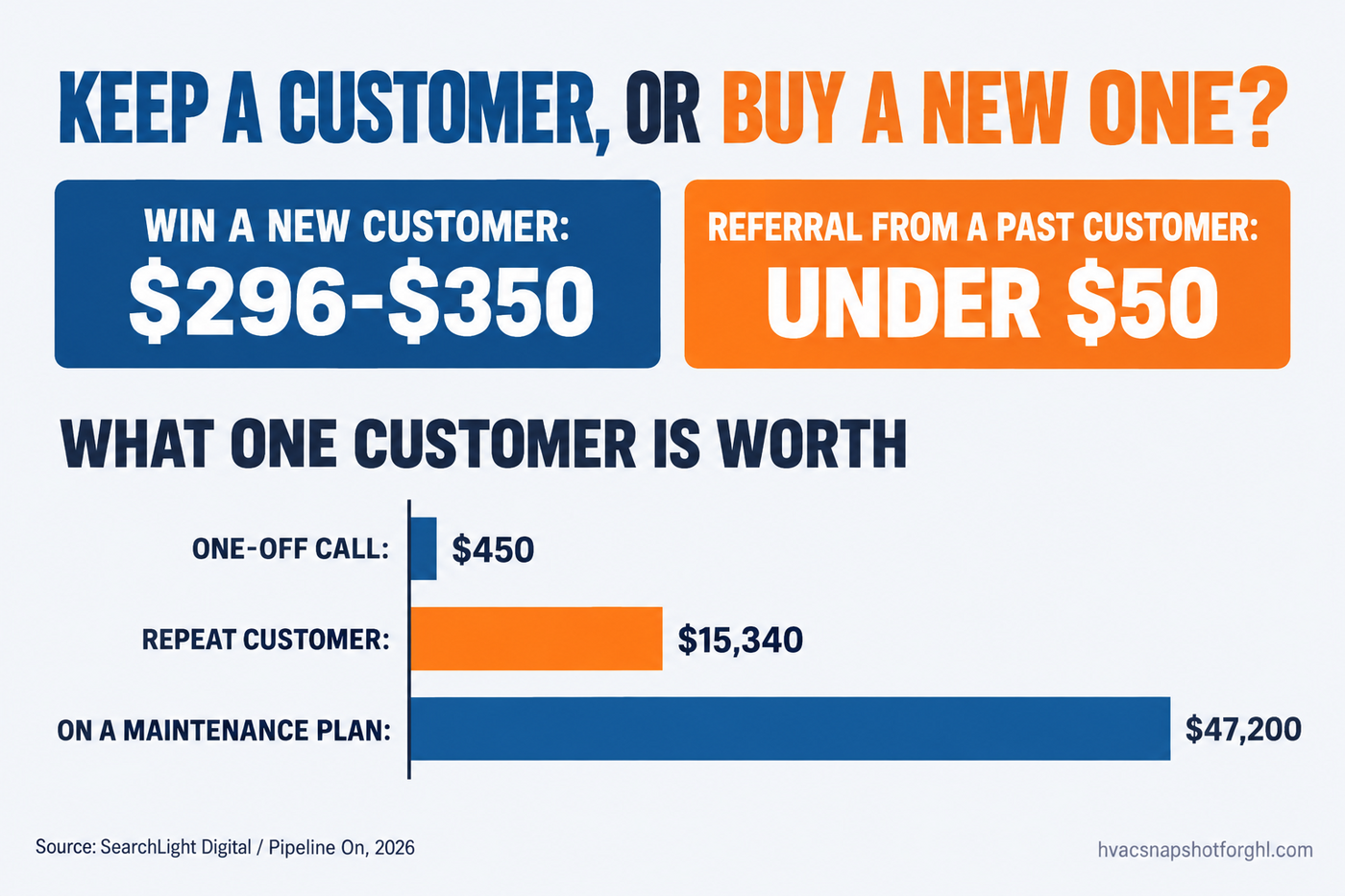
Start with acquisition. A 2026 benchmark of 816 HVAC contractors and $14.9 million in tracked ad spend put the average cost to acquire a new customer at $296 to $350 (SmartAC, 2026). A referral from an existing customer, by the same dataset, costs under $50. You are paying six or seven times more for a stranger than for the person already sitting in your database.
Now the value side. That same research pegs the average residential HVAC customer at a $15,340 lifetime value over a 7 to 10 year relationship. Put them on a maintenance plan and that figure climbs to $47,200, because the plan locks in recurring visits, catches the small repairs, and keeps you in the house for the eventual replacement. Lose that customer after the first job and you did not lose a $450 repair. You lost the next decade.
The reason this leak stays invisible is that nothing breaks when a customer drifts away. The phone still rings, new leads still come in, the trucks still roll. It feels like business as usual. But you are running up a down escalator, spending $300 a head to replace people you already paid to acquire. The shops that quietly win their market are not better marketers. They just stop losing the customers they already have. As Marketing Metrics is widely cited for, you have a 60 to 70% chance of selling to an existing customer against 5 to 20% for a cold one (Advisorpedia), and Bain & Company’s research found that a 5% increase in retention can lift profit anywhere from 25% to 95% (Chief Marketer). The cheapest growth you will ever buy is already in your file.
The repeat-customer lifecycle, stage by stage
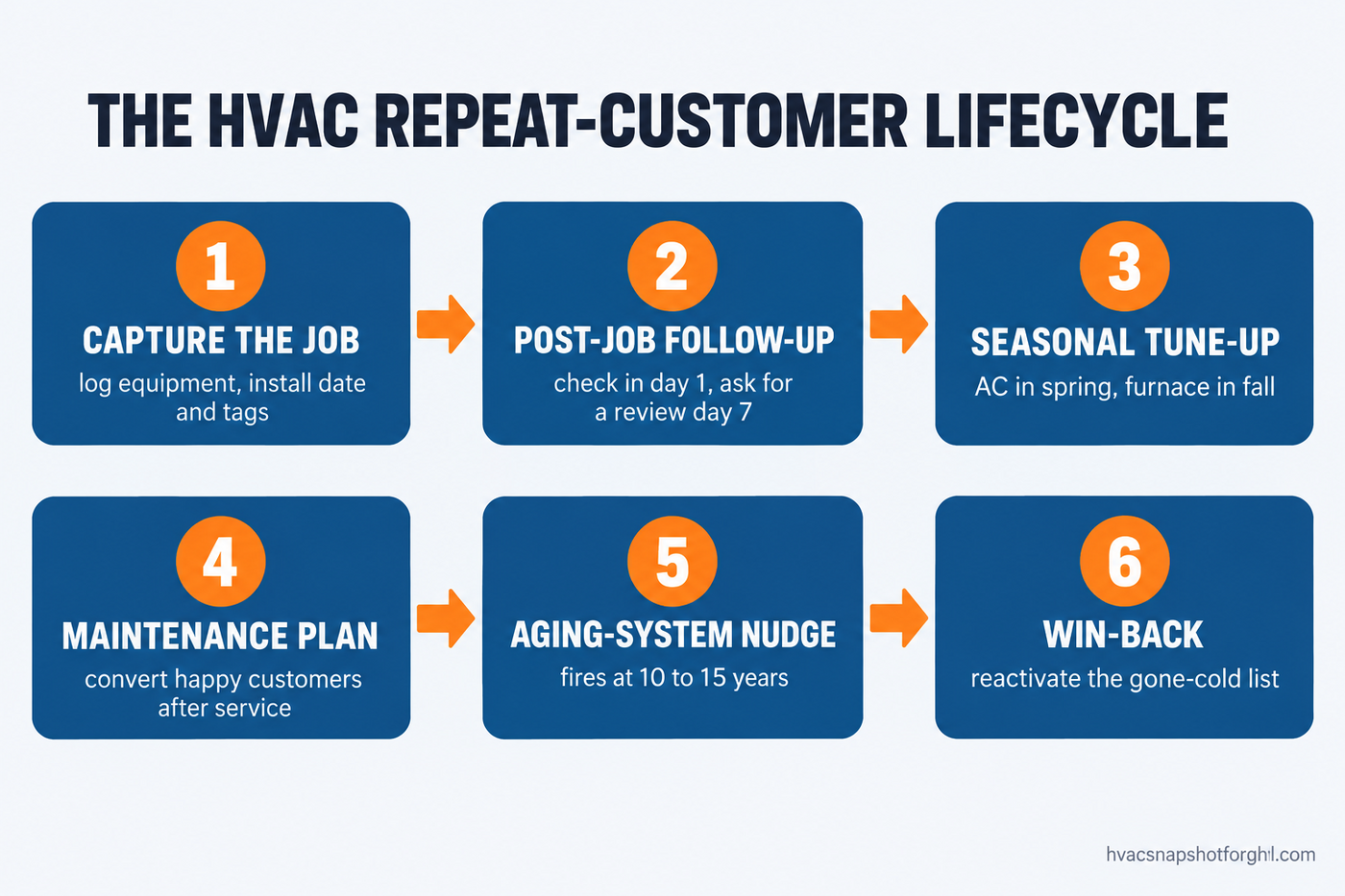
A past customer does not go cold on the day the tech drives away. They cool off over months, through a chain of missed touchpoints, until a competitor’s ad fills the gap. The system that keeps them is a lifecycle: six stages, each with a clear trigger, the actual message, the timing, and the way it fails if you run it half-baked. This is the same structure the HVAC quote follow-up system uses for new leads, pointed at the customers you already earned.
Stage 1: Capture the relationship before the tech leaves
The leak starts on day one. If all you captured was a name and a phone number on a paper ticket, you do not have a customer, you have a receipt. The relationship lives in the details: what equipment you installed, the make and model, the install date, the warranty window, the home’s square footage, and whether they are a homeowner or a renter.
Trigger: the job is marked complete.
What to capture: equipment type and age, install or service date, system brand, warranty expiration, and a tag for the kind of customer they are (install, repair, maintenance). Those tags are what make every later stage fire on time.
Failure mode: the data lives in the tech’s head or on a clipboard that never gets entered. If nobody logs the install date, the 10-year replacement nudge in Stage 5 can never fire, and you have permanently blinded the system to your most valuable customers. Fix it by making job completion in your CRM impossible without the equipment fields filled. No fields, no closed ticket.
Stage 2: The post-job follow-up (days 1 to 30)
The 30 days after a job are when loyalty is cheapest to build and easiest to waste. The customer is paying attention, the work is fresh, and a single well-timed message does more than a year of ads. This window also doubles as your review engine, which feeds the Google reviews that bring in the next customer.
Trigger: 1 day, then 7 days after job completion.
Steal this (day 1 text): “Hi {{first_name}}, it’s Mara at Summit Comfort. Just checking the new system is keeping you cool and everything’s running quiet. Any questions at all, reply right here, you’ve got my number now. Reply STOP to opt out.”
Steal this (day 7 text): “Hey {{first_name}}, glad the install went smooth. If we earned it, a quick Google review helps a local shop like ours a ton: {{review_link}}. No pressure either way. Reply STOP to opt out.”
Failure mode: sending the review ask before you know they are happy. If the install had a hiccup, a review request feels tone-deaf and can trigger the one-star you were trying to avoid. Gate it behind the day-1 check-in: only send the review link to customers who replied positive or raised no issue. Route anyone unhappy to a person, not a review form.
Stage 3: The seasonal tune-up reminder
This is the touchpoint that keeps you in the house twice a year, every year. It is also the single most-skipped automation in the trade, because it depends on the equipment data from Stage 1 that most shops never captured. Done right, it turns a one-time install into a standing appointment.
Trigger: spring for cooling customers, fall for heating customers, based on the equipment tag.
Steal this (spring, cooling): “Hi {{first_name}}, it’s Summit Comfort. Before the first 95-degree day, let’s get your AC tuned up so it doesn’t quit when you need it most. We’ve got spots opening next week, want me to grab you one? Reply STOP to opt out.”
Steal this (fall, heating): “Hey {{first_name}}, heating season’s coming. A quick furnace tune-up now is a lot cheaper than a no-heat call in January. Want me to put you on the schedule? Reply STOP to opt out.”
The reason the inversion matters: a cooling-first shop in a hot market leads with the AC message in April, while a heating-first shop in a cold market leads with the furnace message in September. Fire the wrong one and you are reminding a customer about a system they are not thinking about, which trains them to ignore you.
Failure mode: blasting every customer the same reminder on the same date. A furnace customer who gets an AC tune-up text in April learns your messages are not about them, and tunes out the one that actually matters. Segment by equipment tag or do not send.
Stage 4: The maintenance-plan conversion
The tune-up reminder gets them thinking seasonally. The maintenance plan makes it automatic and multiplies the customer’s value from $15,340 to $47,200 (Pipeline On, 2026). The best moment to offer it is right after a tune-up or a repair, when the customer has just seen the value of a tech in their home.
Trigger: tune-up or repair marked complete, customer not already on a plan.
Steal this (post-service): “Hi {{first_name}}, your system’s in good shape. Most of our customers put it on our Comfort Club: two visits a year, priority scheduling, and 15% off repairs, for less than a dinner out each month. Want the details? Reply STOP to opt out.”
Keeping the plan sold is a separate problem from building it, and it is mostly about your techs. We cover why that breaks down in why your HVAC techs won’t sell maintenance plans, and the agreement itself in the HVAC maintenance agreement template.
Failure mode: pitching the plan to a customer who just got a surprise $1,800 repair bill. They are not in a buying mood. Hold the plan offer for satisfied, no-drama visits, and let the renewal automation handle the rest so plans do not silently lapse a year later.
Stage 5: The aging-equipment replacement nudge
This is the highest-dollar stage, and the one almost nobody runs, because it requires knowing how old the customer’s system is. ENERGY STAR and the U.S. Department of Energy suggest homeowners consider replacing cooling equipment once it passes 10 years and heating equipment past 15 years, when a high-efficiency unit can cut heating and cooling costs by up to 20%. A typical central AC runs 12 to 15 years and a furnace 15 to 20, so your install file is a rolling list of replacement jobs with dates attached.
Trigger: installed equipment reaches 10 years (cooling) or 12 to 15 years (heating), pulled from the Stage 1 data.
Steal this (aging system): “Hi {{first_name}}, your system’s coming up on 12 years, which is right where repairs start adding up fast. No rush and no hard sell, but if you’d like, I can have a tech give you an honest look at whether it’s worth repairing or replacing. Want me to set that up? Reply STOP to opt out.”
Time this well and you reach the customer before the system dies in a heat wave, which is the difference between a planned replacement you win and an emergency changeout that goes to whoever answered first. It also lets you handle the refrigerant conversation on your terms rather than as a panic quote, which matters more than ever under the R-454B refrigerant change.
Failure mode: no install dates in the system, so the nudge never fires and your most valuable customers quietly replace through someone else. This is why Stage 1 is non-negotiable. The data you skip capturing today is the six-figure replacement list you cannot build in five years.
Stage 6: The win-back for the gone-cold list
Some customers already went quiet. You have hundreds of names in QuickBooks or an old spreadsheet who have not heard from you in a year or more. A reactivation campaign is the fastest money in this whole system, because the customers already know you and the cost to reach them is a few cents per text.
Trigger: no job, no contact, and not on a plan for 12-plus months.
The win-back works as a short sequence, not a single message. The full copy is in the next section. The rule is simple: lead with value or a reason to reconnect, not a guilt trip, and always give them a clean way to opt out. The HVAC email marketing and lead nurture playbooks pair with this for the customers who respond better to email than text.
Failure mode: texting a 3-year-old list with no fresh consent and no opt-out, which is both bad manners and a compliance problem. We handle that below.
Steal this: the win-back sequence
Here is the three-touch reactivation sequence for customers who have gone silent. Spread it over about two weeks, stop the moment they reply, and route any real conversation to a person.
The point of the win-back is not to close every name. It is to reopen the relationship cheaply. Even a 5% response on a list of 600 cold customers is 30 reactivated relationships at a few dollars of texting cost, each one worth thousands over time. Compare that to spending $300 a head chasing strangers who have never heard of you.
Average residential HVAC customer value by relationship type. One-off figure is a typical single service call; retained and plan figures from the Pipeline On 2026 benchmark.
Run it for three different shops
The lifecycle is the same for everyone. What changes is where you start and how much you automate. Here is how the same framework plays out at three sizes.
The solo operator (you and one helper). Your whole customer file might be 400 names in QuickBooks. Start with Stage 6, the win-back, because it is pure found money with no new marketing spend. Run a one-time reactivation to the whole list, then turn on Stages 2 and 3 so new jobs do not leak the way the old ones did. Skip nothing, but do it in order. The win-back alone, at even a modest response rate, usually pays for the whole system in the first month. You do not need a CSR. You need the texts to send themselves while you are on a roof.
The 5-truck shop. You have the volume to feel the leak and the chaos to cause it. Your problem is not knowing which customers are due, it is that the data is scattered across a dispatch tool, a spreadsheet, and three techs’ memories. Get every stage firing off the Stage 1 data, and put a real number on it: if you close 40 jobs a month and capture install dates on all of them, in year one you are building a replacement pipeline worth hundreds of thousands by the time those systems age out. Assign one office person to own the replies the automations generate, because at your volume the system will book more than you expect.
The 10-to-15-truck shop. You are big enough that a private-equity-backed competitor is probably outspending you on ads, which is exactly why retention is your edge. You cannot win the ad auction, but you own something they do not: a decade of installed customers with your name already in the house. Run all six stages, segment hard by equipment and plan status, and treat your database as the asset it is. A rollup buys customer lists for real money. Yours is sitting unused in your CRM. If you compete with the big players, retention is how a local shop beats a rollup without matching their ad budget.
Keeping these texts legal: TCPA and 10DLC
Every message in this system is a text or email to a customer, which means it lives under the TCPA and the A2P 10DLC rules that govern business texting in the US. This is not optional fine print. Getting it wrong risks fines and carrier filtering that silently kills your delivery. The good news: because these are your own past customers, compliance is straightforward.
You need prior express consent to text, a clear opt-out in every message (the “Reply STOP to opt out” line in every script above is there for this reason), and you must honor opt-outs immediately. For the win-back of an old list, the cleanest path is customers who already consented when you did the original work. If you cannot show consent for a given name, reach them by a channel you can prove, or re-earn the opt-in before you text.
On the cost side, texting at this scale is cheap but not free. Registering your business to send (A2P 10DLC) runs a roughly $24.50 one-time fee for a sole proprietor or low-volume brand and about $71.91 for a high-volume registration, plus $2 to $10 per campaign per month and a carrier pass-through of around $0.003 per message (HighLevel fee schedule). Against a $15,340 customer, that is rounding error. The full rulebook is in our 10DLC and TCPA guide for HVAC contractors and the exact wording to use is in the SMS consent opt-in language post.
Objections, answered straight
“My customers don’t want to be texted.” Some don’t, and the opt-out handles them in one tap. But the data says most do: text is how people prefer to handle logistics now, and a short, useful, named message about their own equipment reads as service, not spam. The customers who opt out were never going to be repeat business anyway. The ones who stay are the ones worth keeping.
“I already have all their info in QuickBooks.” Having the names is not the same as using them. QuickBooks is an accounting tool, not a follow-up engine. It will not fire a tune-up reminder in April or flag a 12-year-old system. The information sitting in your accounting software is exactly the gold mine this system turns into booked jobs. The data is the hard part, and you already did it. The automation is the easy part you are skipping.
“I’m too busy in season to do this.” That is the whole point. The system runs when you are too busy to think about it, which is precisely when past customers slip away to a competitor. You set the triggers once in the slow season and they fire forever. The busiest shops need this most, because their owners have the least time to remember who is due.
“Won’t this annoy people if I message them too much?” It would, if you blasted everyone the same thing constantly. This system does the opposite: each message is triggered by something real about that specific customer, their job, their equipment age, their season, and capped so nobody gets more than a few touches a year. Relevance is the difference between a reminder and a nuisance. Segment by the Stage 1 tags and you stay firmly on the right side of it.
“Can’t I just do this myself when I get a minute?” You can, and you won’t, for the same reason it is not happening now. Manual follow-up loses to the emergency on the truck every single time. The value is not in knowing you should stay in touch. Every owner knows that. The value is in a system that does it whether or not you remember, which is what moves retention from a good intention to recovered revenue.
Frequently asked questions
How do I win back old HVAC customers who haven't heard from me in years?
Run a three-touch reactivation sequence over about two weeks: a friendly check-in text, a short email with a returning-customer tune-up offer and one-tap booking, then a final low-key text. Lead with value, not guilt, include an opt-out in every message, stop the moment they reply, and route real conversations to a person. Only text customers you can show consented to hear from you.
What is HVAC customer retention actually worth?
A lot. A 2026 benchmark puts the average residential HVAC customer's lifetime value at about $15,340 over 7 to 10 years, and $47,200 for a customer on a maintenance plan. Winning a brand-new customer costs $296 to $350, while a referral from a past customer costs under $50. Keeping customers is six to seven times cheaper than replacing them.
How often should I contact past HVAC customers?
A few relevant touches a year, triggered by something real. That means a post-job follow-up in the first 30 days, a seasonal tune-up reminder matched to their equipment (spring for AC, fall for heating), a maintenance-plan or renewal note, and a replacement nudge when their system ages out. Capped and relevant reads as service. Constant and generic reads as spam.
Is it legal to text my past HVAC customers?
Yes, if you follow the TCPA and A2P 10DLC rules: get prior express consent, include a clear opt-out like 'Reply STOP to opt out' in every message, and honor opt-outs immediately. Because these are your own past customers, most already consented when you did the original work. If you cannot prove consent for a name, re-earn it before you text.
What does it cost to run automated texts to my customer list?
Business texting in the US requires A2P 10DLC registration, roughly a $24.50 one-time fee for a sole proprietor or low-volume brand and about $71.91 for high volume, plus $2 to $10 per campaign per month and about $0.003 per message in carrier fees. Against customers worth thousands each, the cost is negligible.
I only have my customers in QuickBooks. Can I still do this?
Yes, and the win-back campaign is the place to start. Export your customer list, load it into a CRM that can send triggered texts and emails, and run a reactivation sequence to the whole list. From there, start capturing equipment type and install date on every new job so the seasonal and replacement automations have the data they need to fire.