
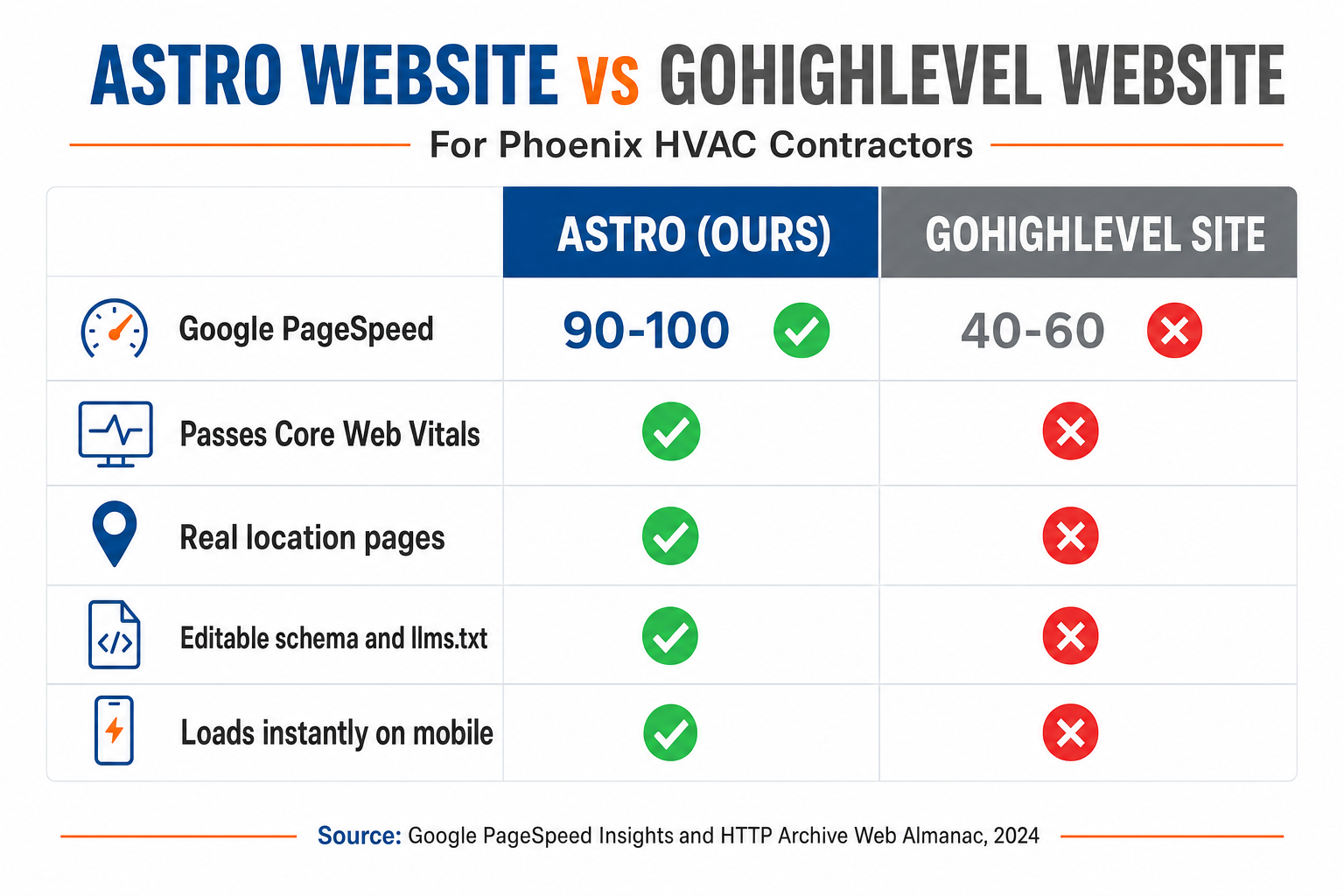
It’s 114°F in Phoenix and a homeowner’s AC just quit. They grab their phone, search “AC repair near me,” and tap the first shop. The site takes six seconds to paint on a hot LTE connection — so before your hero image even loads, they’ve already backed out and tapped the next contractor. You didn’t lose that job on price or reviews. You lost it on load time, and you never even knew the call existed.
That’s the quiet, expensive difference between the two most common ways an HVAC shop gets a website built today: a GoHighLevel (GHL) page-builder site versus a static site built on the Astro framework. Both can look fine in a screenshot. Under the hood — where Google, AI answer engines, and a sweating homeowner on a phone actually judge you — they are not close. Here’s the honest, sourced comparison, framed for a Phoenix market where the AC calls don’t wait.
On this page
- What’s the real difference between an Astro site and a GoHighLevel site?
- Why page speed decides who wins the Phoenix HVAC call
- Astro vs GoHighLevel vs WordPress/Wix: the side-by-side
- Core Web Vitals in 2026: the scoreboard Google actually uses
- SEO & AI search: why a fast, structured site gets found in Phoenix
- “But GoHighLevel builds my funnels” — where each tool belongs
- What a fast HVAC website should actually include
- Frequently asked questions
What’s the real difference between an Astro site and a GoHighLevel site?
An Astro site is a static, pre-built website that serves finished HTML pages from a global edge network, so pages appear almost instantly. A GoHighLevel site is generated by an all-in-one marketing platform’s drag-and-drop page builder — convenient to spin up, but heavier and slower because it loads a builder’s scripts, styles, and tracking on every visit. Both put a website on the internet; they get there in very different ways, and the way matters.
Think of it like the trade. A GHL page builder is the all-purpose service van — it does everything: CRM, texting, calendars, funnels. That versatility is fantastic for running your back office. But when the job is one specific thing done fast and clean — a public website a homeowner loads on a phone in 114° heat — a purpose-built tool wins. Astro is that purpose-built tool: a modern framework whose entire design goal is shipping the least possible code so pages load fast.
The practical upshot: a GHL-built site tends to arrive with page-builder overhead baked in, while a well-built Astro site arrives lean by default. On a fast office desktop you may never notice. On a homeowner’s phone on cellular data in July — which is where most of your emergency AC traffic actually lives — that difference is the job.
Why page speed decides who wins the Phoenix HVAC call
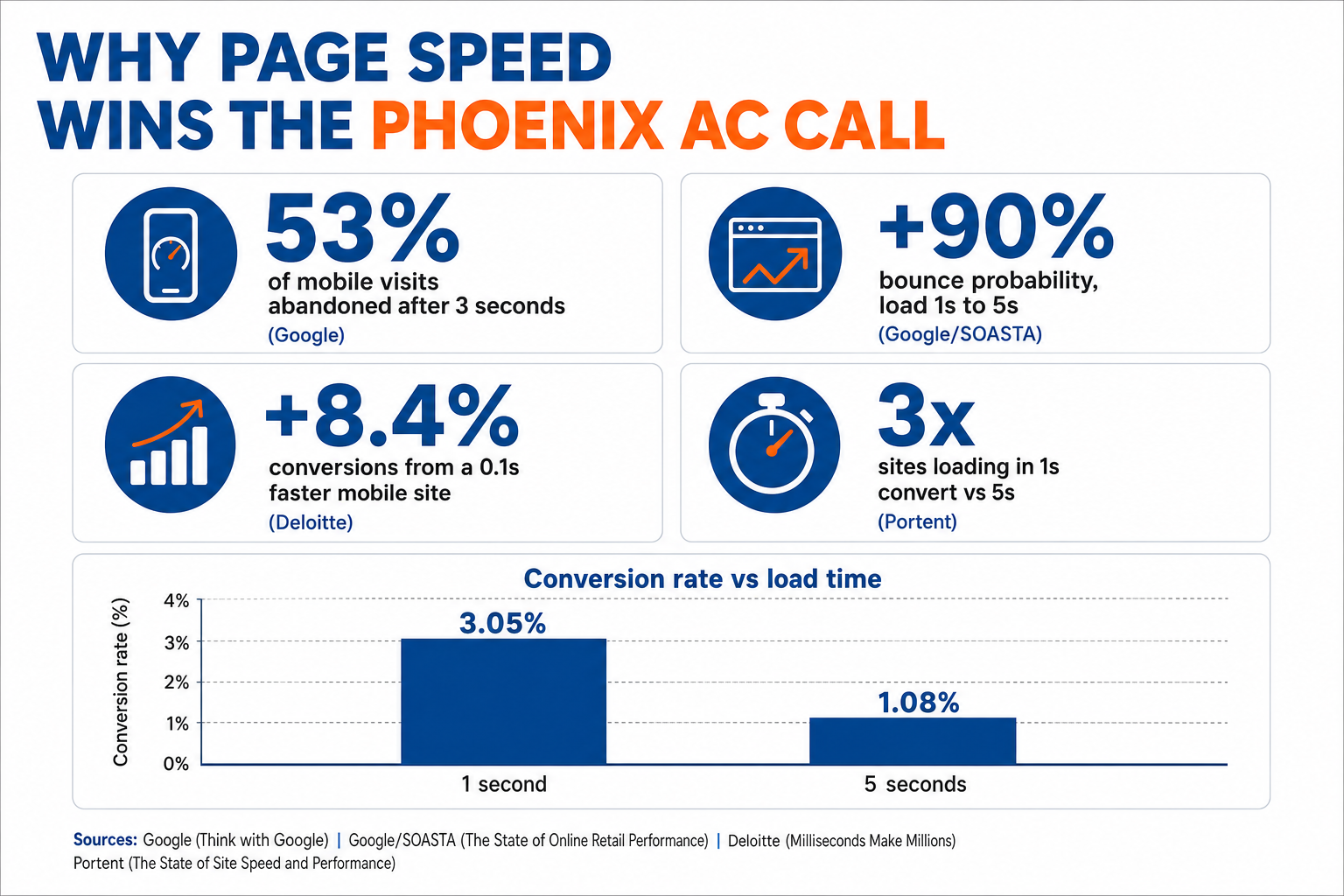
Phoenix is the sharpest possible test case for website speed. The Phoenix–Mesa–Chandler metro is home to more than 5.1 million people (U.S. Census Bureau, 2024), and in 2024 the city set an all-time record of 113 consecutive days at or above 100°F — shattering the old record of 76 days (Washington Post, 2024). When it’s that hot for that long, a dead compressor isn’t an inconvenience — it’s an emergency, and the homeowner is booking the first shop that answers, not the best one.
That urgency runs straight into a hard fact about how people behave on slow pages. Google’s research is blunt: 53% of mobile site visits are abandoned if a page takes longer than three seconds to load (Google). And it compounds fast — Google and SOASTA found that as mobile page load time grows from one second to three, the probability of a bounce rises 32%; from one to five seconds, it rises 90% (Google/SOASTA, 2017).
Now flip it to the money side. Speed doesn’t just cut bounces — it lifts the conversion rate of the people who do stay. Portent’s analysis of roughly 100 million page views found sites loading in one second convert at about 3.05%, versus about 1.08% for sites loading in five seconds — nearly a 3× gap (Portent). And a Deloitte study commissioned by Google, Milliseconds Make Millions, found that a mere 0.1-second improvement in mobile site speed lifted retail conversion rates by 8.4% and average order value by 9.2% (Deloitte, 2020).
For an HVAC shop, “conversion” is a booked service call. A site that loads in a blink books more of the traffic you’re already paying to generate — whether that traffic comes from Google, Local Services Ads, or the Facebook ad you ran last week. Speed multiplies everything upstream of it.
I love GoHighLevel — I build in it every day. But I stopped putting clients’ public websites on the GHL page builder years ago. The moment a homeowner is on a phone in the heat, the builder’s overhead is a tax you pay on every single visit, and it’s the visits you can least afford to lose.
Astro vs GoHighLevel vs WordPress/Wix: the side-by-side
Most HVAC shops are choosing among four options: a GoHighLevel page-builder site, WordPress, Wix, or a purpose-built Astro site. Here’s how they line up on the things that decide whether the phone rings.
How the four common HVAC website options compare
| What matters | Astro (ours) | GoHighLevel site | WordPress | Wix |
|---|---|---|---|---|
| Typical Google PageSpeed (mobile) | 90–100 (guaranteed) | 40–60 | 35–60 | 40–65 |
| How pages are served | Static, from the edge | Builder renders per visit | PHP + plugins per visit | Hosted builder per visit |
| JavaScript weight | Minimal by design | Heavy (builder + tracking) | Grows with every plugin | Heavy (builder runtime) |
| Editable meta, schema & llms.txt | Yes — full control | Limited | Plugin-dependent | Limited |
| Dedicated city / location pages | Built in | Manual & clunky | Manual | Manual |
| Custom code & integrations | Unlimited | Constrained to platform | Yes, with upkeep | Very limited |
| Who maintains it | We do (managed) | You / your agency | You (updates, security) | You |
| What it's genuinely great at | Fast public website + SEO | CRM, funnels, automation | Blogging, flexibility | Fast DIY setup |
Read the last row carefully, because it’s the whole point. GoHighLevel is genuinely excellent at what it was built for — the CRM, the pipelines, the missed-call text-back, the review requests, the automations. It is not built to be the fastest, most search-optimized public website in your market, and asking it to be one is using the service van to win a drag race.
The PageSpeed numbers above are directional ranges — every site differs — but the pattern is consistent and it’s corroborated by independent data. HTTP Archive’s 2024 Web Almanac found that only about 48% of mobile sites passed all three Core Web Vitals, and platform matters a great deal: page-builder- and CMS-generated sites cluster well below lightweight static sites on those metrics (HTTP Archive Web Almanac, 2024). “90+ guaranteed” isn’t marketing bravado — it’s the tier a purpose-built static site can actually live in, and most builder sites can’t.
Core Web Vitals in 2026: the scoreboard Google actually uses
You don’t have to take anyone’s word on speed. Google publishes the exact scoreboard: Core Web Vitals. There are three, each with a “good” threshold measured at the 75th percentile of real visits (web.dev):
- Largest Contentful Paint (LCP) — good is ≤ 2.5 seconds. How fast your main content paints. A slow builder site with a big hero image and blocking scripts routinely blows past this.
- Interaction to Next Paint (INP) — good is ≤ 200 milliseconds. How fast the page responds when a homeowner taps “Call” or “Book.” INP officially replaced First Input Delay in March 2024, and heavy JavaScript is its enemy.
- Cumulative Layout Shift (CLS) — good is ≤ 0.1. How much the page jumps around while loading. Nothing loses a tap-to-call like the button sliding out from under a thumb.
Here’s why this isn’t just a developer’s report card: Google confirms Core Web Vitals “are used by Google’s ranking systems” as part of its page experience signals (Google Search Central). A site that fails CWV is fighting Google’s ranking algorithm and the homeowner’s patience at the same time. And the field has been getting more competitive: the share of mobile sites passing all three vitals has climbed from roughly 20% in 2020 to about 48% in 2024 (HTTP Archive Web Almanac, 2024).
The takeaway for a Phoenix contractor: passing Core Web Vitals is still a genuine edge, not table stakes. If your site is in the roughly half that fails, a competitor who fixed it is out-ranking and out-converting you on the same searches.
SEO & AI search: why a fast, structured site gets found in Phoenix
Speed and SEO aren’t two separate projects — Google folds page experience into ranking, so a fast site is a better-ranking site, all else equal. But for a local HVAC shop, three more structural things decide whether you show up when a Phoenix homeowner searches:
1. Real location pages. A homeowner in Scottsdale searches differently than one in Chandler or Mesa. A proper Astro build ships individually optimized pages for every city and neighborhood you serve — the single biggest lever for winning the local map, and the thing page-builder sites make painful to do well. This is the backbone of HVAC local SEO.
2. Clean structured data (schema). Search engines — and increasingly AI answer engines — read your business facts from schema markup, not from your hero image. A site that emits correct LocalBusiness, Service, and FAQ schema by default hands Google and the AIs your service area, hours, and answers in a format they can’t misread. That’s now the price of admission for showing up in AI search results like ChatGPT and Google AI Overviews.
3. A machine-readable foundation. Correct sitemap, robots.txt, and an llms.txt file let both search crawlers and AI crawlers index your shop cleanly. These are trivial on a purpose-built site and awkward-to-impossible to control on a locked-down builder.
Why this matters so much locally: Google found that 76% of people who search on a smartphone for something nearby visit a related business within a day, and 28% of those searches result in a purchase (Think with Google). Near-me intent is high-intent — the homeowner is ready to book. A fast, well-structured site turns that intent into a booked call; a slow, invisible one hands it to the shop down the road.
“But GoHighLevel builds my funnels” — where each tool belongs
This is the part where most “Astro vs GHL” takes go wrong by treating it as either/or. It isn’t. The smart setup is both, each doing what it’s best at. As someone who builds in GoHighLevel every day, here’s the division of labor I recommend:
The right tool for each job
Your fast, rankable website: home, services, real Phoenix-area location pages, blog, schema, llms.txt. Loads instantly, passes Core Web Vitals, ranks locally, and books the homeowner in the heat.
Your CRM and automation engine: pipelines, missed-call text-back, appointment reminders, review requests, maintenance-plan renewals, AI receptionist. The machine that works the leads the fast site captures.
A fast Astro site is the front door — the thing a stranger loads and judges in under two seconds. GoHighLevel is the back office — where captured leads get worked, nurtured, and turned into repeat maintenance-plan customers. Point your website forms and your AI chat widget into GHL, and you get the best of both: a site that wins the click and a CRM that never drops the lead. That’s exactly how our prebuilt HVAC website is wired — fast on the outside, fully automated on the inside.
If you want the follow-up engine that sits behind the site, the HVAC Snapshot for GHL drops the whole CRM, AI receptionist, and review system into your GoHighLevel account in 24 hours. The website catches the lead; the snapshot makes sure your shop actually books it — even after hours, which is where most HVAC revenue leaks.
What a fast HVAC website should actually include
If you’re weighing a rebuild, here’s the spec sheet a modern HVAC site should hit — and what we build into every Astro HVAC website:
- 90+ Google PageSpeed, guaranteed on mobile and desktop — the tier that passes Core Web Vitals.
- Up to 60 pages, including a dedicated page per service and real location pages for every city you serve.
- Schema, AEO & GEO ready — LocalBusiness, Service, and FAQ markup that Google and AI answer engines can read.
- Sitemap, robots.txt & llms.txt shipped correctly so search and AI crawlers index you cleanly.
- Free domain + fully managed Cloudflare hosting — no separate hosting, SSL, or maintenance bills.
- An AI chat widget + review-collection automation so the fast site also captures and converts.
The bottom line for a Phoenix HVAC shop: keep GoHighLevel for the CRM and automation you already love, but stop asking it to be your public website. In a market where it’s 100°F+ for four months straight and the AC calls go to whoever loads and answers first, a fast, well-structured Astro site isn’t a nice-to-have — it’s the difference between catching the job and funding your competitor’s summer.
Frequently asked questions
Is an Astro website really faster than a GoHighLevel website for an HVAC shop?
Generally, yes — and by a wide margin on mobile. Astro is a static-first framework that ships almost no JavaScript and serves finished pages from a global edge network, so pages paint almost instantly. A GoHighLevel site is generated by a page builder that loads builder scripts, styles, and tracking on every visit. Our Astro HVAC sites guarantee a 90+ Google PageSpeed score, a tier most page-builder and CMS sites never reach — HTTP Archive found only about 48% of mobile sites passed all three Core Web Vitals in 2024.
Should Phoenix HVAC contractors drop GoHighLevel entirely?
No. GoHighLevel is excellent at what it's built for — CRM, pipelines, missed-call text-back, review requests, appointment reminders, and automation. The recommendation is to use Astro for your fast, rankable public website and keep GoHighLevel as the back-office engine behind it. Point your website forms and AI chat widget into GHL so the fast site captures leads and the CRM works them. Best of both, each doing its job.
Does website speed actually affect my Google ranking?
Yes. Google confirms Core Web Vitals are used by its ranking systems as part of page experience signals, alongside HTTPS and mobile-friendliness. The three vitals and their 'good' thresholds are LCP ≤ 2.5s, INP ≤ 200ms, and CLS ≤ 0.1, measured on real visits. Good vitals don't guarantee the top spot, but failing them means fighting the algorithm and the homeowner's patience at once — and about half of mobile sites still fail.
Why does page speed matter so much for AC repair calls specifically?
Because AC emergencies are urgent and mobile. In a market like Phoenix — which hit a record 113 straight days at or above 100°F in 2024 — a homeowner with a dead AC books the first shop that loads and answers, not the best-reviewed one. Google found 53% of mobile visits are abandoned if a page takes longer than three seconds to load, so a slow site loses the most valuable, ready-to-book traffic you have.
What does a fast Astro HVAC website cost, and who maintains it?
Our Astro HVAC websites are $497 one-time plus $97/month, and the site goes live within 10 working days of the onboarding call. The monthly fee covers managed Cloudflare hosting, your domain, SSL, and ongoing maintenance plus up to 10 change tickets a month — no separate hosting or plugin bills. We maintain it, so you run the trucks while the website stays fast, secure, and current.
Will switching to a faster site hurt my existing SEO?
Handled correctly, a rebuild on a fast, well-structured framework helps SEO rather than hurting it — you keep your URLs and content, gain real location pages and clean schema, and pass Core Web Vitals. Rankings typically build over 3–5 months as Google recrawls and the page experience signals register. Anyone promising day-one ranking jumps isn't being straight with you.
Rachel Okonkwo
GoHighLevel Automation Consultant · Columbus, OH
Rachel builds GoHighLevel workflows for home-service contractors and the agencies that white-label for them. She has wired up review engines, maintenance-plan renewals, and AI receptionists across dozens of HVAC accounts — which is exactly why she’s opinionated about keeping the public website off the page builder and letting each tool do what it’s best at.
Related reading
- HVAC Local SEO: How to Rank in the Google Map Pack in 2026 — the location-page and reviews foundation a fast site is built on.
- How HVAC Contractors Get Found in AI Search in 2026 — why schema and clean structure decide whether AI answer engines quote your shop.
- After-Hours Missed Calls Are Costing HVAC Shops $40K+/Year — what happens to the lead once your fast site captures it.
- Speed to Lead for HVAC: Why the First 5 Minutes Decide the Job — page speed wins the click; speed-to-lead wins the booking.