

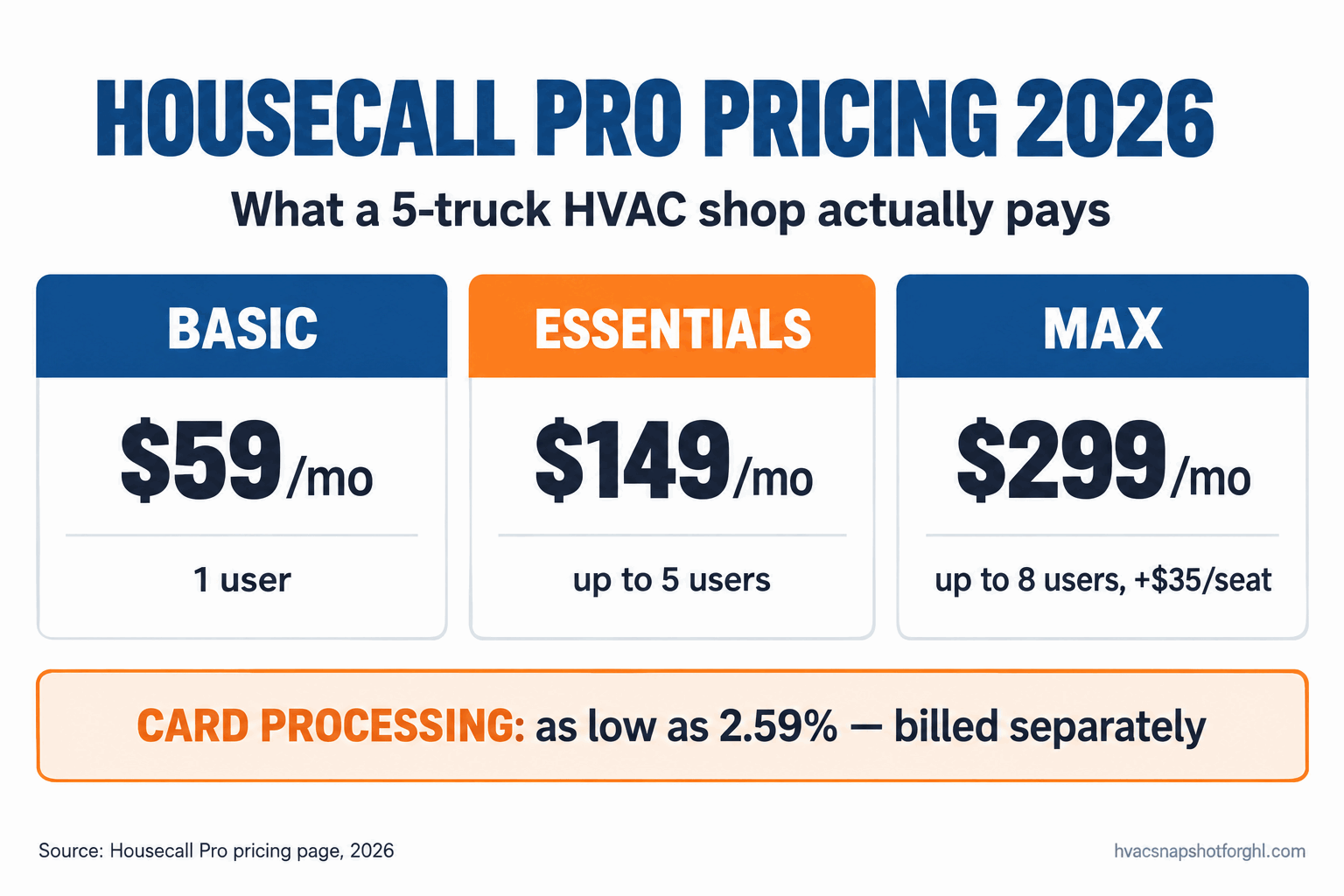
Unlike most field software, Housecall Pro does something rare: it puts the price right on the website. You can see Basic, Essentials, and Max without booking a demo or dodging a rep. That honesty is real, and it is also the trap. The three numbers on the plan card are the smallest part of what you will actually pay every month.
Here is the short version. Housecall Pro runs $59 a month for Basic (1 user), $149 for Essentials (5 users), and $299 for Max (8 users) on annual billing, with extra Max seats at $35 each (Housecall Pro pricing). A 5-truck HVAC shop lands around $3,588 a year in subscription. But card processing, tier-gating, and add-ons are where the money really goes, and this teardown walks every one.
On this page
- What Housecall Pro actually is, and who it fits
- The real Housecall Pro price, tier by tier
- The costs that never show up on the plan card
- The seat math: how the bill behaves as you add trucks
- Three scenarios: solo, 5 techs, 12 techs
- Housecall Pro vs the rest of the field
- The questions to ask before you pick a tier
- The leak Housecall Pro cannot fix
- The 10DLC bill every texting shop pays
- Objections and honest answers
- Frequently asked questions
What Housecall Pro actually is, and who it fits
Most of the field service world hides the number. ServiceTitan and FieldEdge make you sit through a demo before a rep says a price out loud; Housecall Pro does not. The tiers are on the pricing page, monthly and annual rates side by side (Housecall Pro). For a skeptical owner burned by “let’s build you a custom quote,” that is a genuine point in its favor. The trap is that a plan card is a sticker price, not a total, and the published number makes you feel like you did your homework right where the real money starts.
Housecall Pro is a field service platform built for home-service trades: HVAC, plumbing, electrical, cleaning. It covers the core of running a shop: scheduling and a dispatch board, estimates and invoices, a customer database, mobile apps for techs, online booking, payments, and review requests. Its real selling point is ease of use: a former tech who now owns the shop can set it up without a consultant. It fits a residential shop between one and fifteen trucks that wants a clean, modern tool without the price tag or implementation project of enterprise software. The question is not whether Housecall Pro can run your shop. It can. It is which tier you land on once you need the features HVAC shops lean on, and what the payments side does to your bill.
The real Housecall Pro price, tier by tier
Published rates on annual billing, with month-to-month in parentheses. Annual locks you in for the year but knocks the monthly rate down.
Basic, $59/mo ($79 month-to-month), one user. Scheduling, estimates, invoicing, the customer database, and review management, which Housecall Pro includes from the bottom tier (Housecall Pro). One seat only; add a second person and you are off Basic.
Essentials, $149/mo ($189 month-to-month), up to five users. The step most small shops expect to land on. Adds QuickBooks sync, more reporting, and the online booking a real crew needs. What it does not cover is recurring membership billing, and that is the catch below.
Max, $299/mo ($329 month-to-month), up to eight users. The tier where the HVAC-specific features live. Recurring Service Plans, the piece that bills your maintenance agreements automatically, sits only on Max (Housecall Pro). So does the sales proposal tool, listed as a “$40/mo value.” Extra seats past eight run $35 a month each, cheap compared with per-tech tools.
On annual billing that is $708, $1,788, and $3,588 a year. For pure subscription, Housecall Pro is one of the cheaper options a real HVAC shop can run on. The catch: the two features that matter most to this trade, membership billing and good proposals, both live on the most expensive tier, so “I’ll just get Essentials” rarely survives contact with how an HVAC shop actually sells.
The costs that never show up on the plan card
The subscription is the part they print. These are the line items that land after you sign, and for an HVAC shop the first one is usually the biggest number on the whole bill.
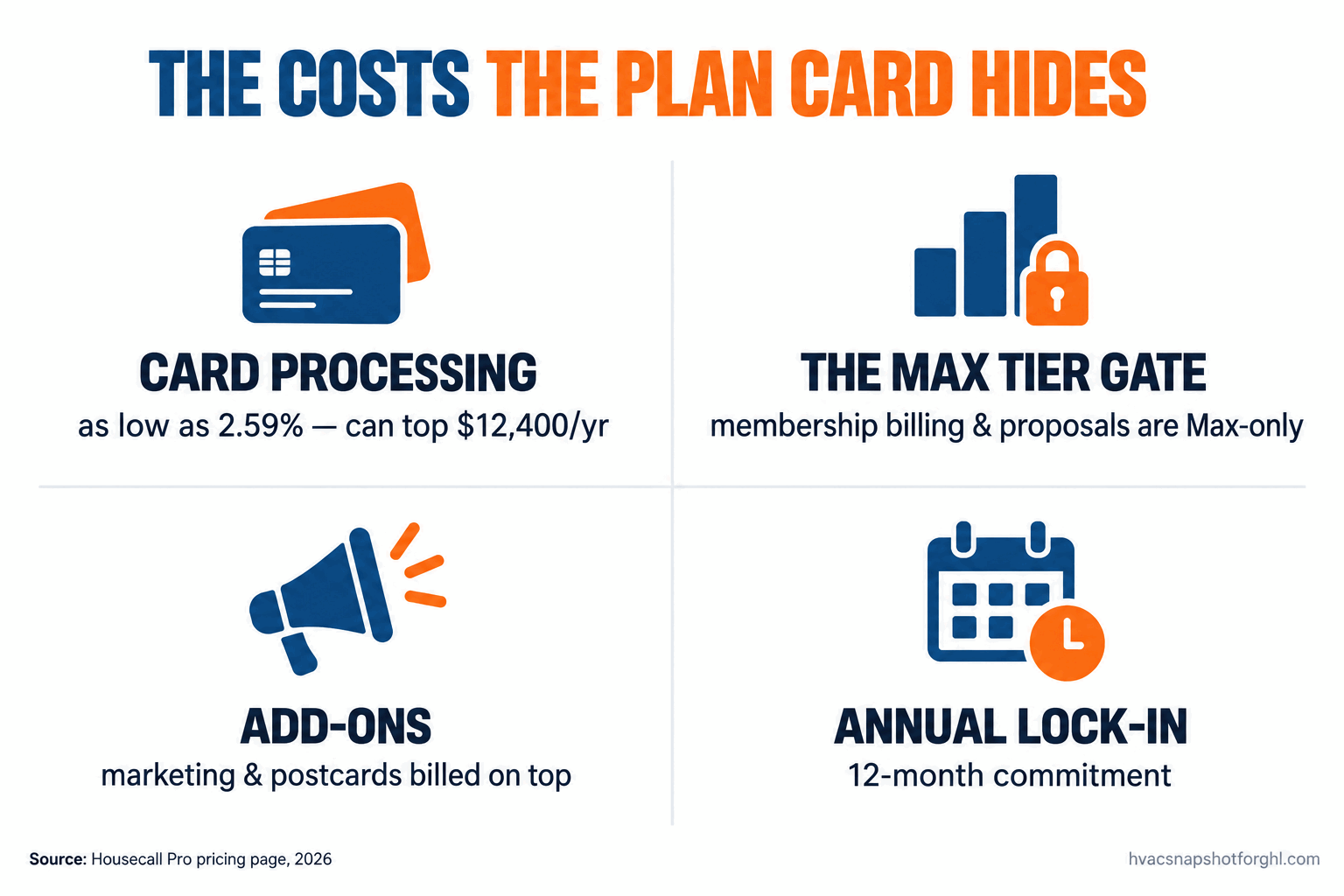
Card processing, the one that dwarfs everything. Housecall Pro’s page quotes processing “as low as 2.59%,” with bank payments at a 1% fee (Housecall Pro). “As low as” is doing work there; your real rate depends on card mix. A shop collecting $40,000 a month on cards at 2.59% pays about $1,036 a month, roughly $12,400 a year, more than triple the $3,588 Max subscription. The number that moves your bill is the percentage on your revenue, not the seat price. Ask what rate you actually qualify for, and whether you can route more customers to the 1% bank option.
The Max tier gate. Recurring Service Plans and the sales proposal tool are Max-only (Housecall Pro), and for an HVAC shop those are not nice-to-haves. Maintenance agreements are the recurring revenue that carries you through February, and good-better-best proposals are how you sell a condenser instead of a repair. How it breaks: you sign up for Essentials at $149, discover you cannot auto-bill your members, and get bumped to $299 for the one feature you came for.
Add-ons and the annual lock-in. Beyond the tiers, extras show up: marketing tools, postcard campaigns billed per piece (reviewers put postcards around $0.86 to $1.09 each, ServicePro teardown, 2026), and premium modules, none of it in the headline number. And the cheaper annual rate is a 12-month commitment, so leaving mid-term means eating the balance. Fix both by making the rep itemize every add-on, and by starting month-to-month until your tier is settled.
The seat math: how the bill behaves as you add trucks
Here is where Housecall Pro genuinely beats the enterprise tools. It does not charge full per-tech pricing. Max includes eight users, and seats past that are $35 a month each (Housecall Pro). Compare that with ServiceTitan, where contractors report $245 to $500 per technician per month (Projul, 2026). On ServiceTitan, your ninth tech is another $300 to $500 a month. On Housecall Pro Max, your ninth tech is $35.
Run it out. A five-truck shop on Max is about $3,588 a year; a twelve-truck shop, at eight included seats plus four extra techs and a couple of office users, is roughly $5,300. The feature set did not change and the bill barely moved, the opposite of the per-seat creep that drives shops off ServiceTitan and FieldEdge (we walk the whole per-seat versus flat question in the per-tech versus unlimited-user breakdown). What does grow is card processing, because it scales with revenue, not headcount. The picture is flipped from the ServiceTitan story: the seats stay cheap and the payments line is the one to watch.
Three scenarios: solo, 5 techs, 12 techs
Solo operator, one truck. Basic at $59 a month, about $708 a year, covers scheduling, invoicing, reviews, and payments, a fair price for a one-person shop. The catch comes the day you want to sell maintenance plans, because recurring billing is a Max feature. If memberships are not on your roadmap yet, Basic is a good deal. If they are, you are looking at a jump to $299 sooner than you think.
Five techs. Housecall Pro’s sweet spot. You will almost certainly land on Max, because five techs plus an office person is six or seven seats and because you want recurring plans and proposals. Call it $3,588 a year, cheap for the capability. But the number that matters at this size is card processing on your volume, often two to four times the subscription. The five-tech decision is not about the $3,588. It is about the processing rate you negotiate.
Twelve techs. Where Housecall Pro quietly wins on seats. Roughly $5,300 a year for twelve trucks is a fraction of what a per-tech tool charges, where ServiceTitan would run well into five figures plus implementation (Projul, 2026). The question at twelve trucks is whether Housecall Pro has the reporting and dispatch depth a larger operation needs, not whether you can afford the seats.
Housecall Pro vs the rest of the field
Where Housecall Pro sits against the common alternatives:
Housecall Pro vs common small-shop HVAC software (2026)
| Platform | Published price? | Pricing model | Starting cost (reported / published) |
|---|---|---|---|
| Housecall Pro | Yes | Tiered, cheap extra seats | $59-$299/mo + 2.59% card |
| Jobber | Yes | Tiered, per user | $49-$499/mo + $29/user |
| Service Fusion | Yes | Flat, unlimited users | ~$208-$533/mo |
| FieldEdge by Xplor | No, demo only | Per seat (office + tech) | ~$100 office / ~$125 tech per mo + setup |
| ServiceTitan | No, demo only | Per technician | ~$245-$500/tech/mo + $5K+ setup |
The honest read: on subscription, Housecall Pro sits near the bottom of the range and scales the best of the per-seat tools, because the extra seat is $35, not $300. Jobber publishes similar rates, $49 to $499 plus $29 per extra user (Jobber pricing); Service Fusion counters with a flat, unlimited-user model, around $208 to $533 a month, that wins once headcount gets large (Capterra, 2026). FieldEdge and ServiceTitan hide the number and charge per tech. For the full head-to-head, see the best ServiceTitan alternatives and the complete HVAC software pricing teardown.
The questions to ask before you pick a tier
The price is public, but the real total depends on answers the plan card does not give. Get these before you sign.
Get those answered and you will know your real monthly number, not the sticker price.
The leak Housecall Pro cannot fix
Here is the part no field service tool puts on its pricing page, and it matters more than which tier you choose. Housecall Pro, Jobber, FieldEdge, ServiceTitan, every one manages a job you already booked. They do not book it. For most small shops, the money does not leak inside the software. It leaks upstream, at the phone.
Picture a July afternoon in Phoenix. Your tech is on a rooftop with a dead condenser, your office line rings, and it rolls to voicemail because the one person who answers phones is at lunch. That caller does not leave a message. They tap the next shop on Google, and the $9,000 changeout is gone. No dispatch board recovers a call nobody answered. That is where a small shop should spend its first automation dollar, before it debates Essentials versus Max: making sure every call gets answered or texted back inside a minute, day or night. It is a different category of tool than field software, and it is the one that moves the top line.
The 10DLC bill every texting shop pays
One cost shows up no matter which field tool you buy, because the phone carriers set it, not the vendor. The moment you send business texts in the US, reminders, “tech is on the way,” review requests, you are in A2P 10DLC territory and pay registration and per-message fees on top of your subscription.
The pieces are small but real: a one-time registration (around $24.50 low-volume, roughly $71.91 standard high-volume), a per-campaign monthly fee of $2 to $10, and a per-message carrier surcharge starting near $0.003 per segment (Twilio 10DLC pricing). Same bill whether you text through Housecall Pro, ServiceTitan, or a custom build. The part that bites is compliance: texting without proper consent and a clean opt-out is a TCPA exposure whose penalties dwarf the carrier fees. We break it down, with the exact consent wording, in the HVAC TCPA and 10DLC guide.
Objections and honest answers
“Housecall Pro is cheap, why are you making it complicated?” Because the subscription is the cheap, honest part. Card processing is neither printed loudly nor cheap, and on real HVAC revenue it is the biggest line on the bill. Cheap seats plus expensive processing can still total more than a pricier-seat tool with a better card rate. The only way to know your number is to run your own card volume against the rate you qualify for, not the “as low as” floor.
“I’ll just get Essentials and save the money.” Maybe, if you do not sell maintenance plans or need real proposals. But recurring billing and the proposal tool are Max features (Housecall Pro), and for an HVAC shop those two are usually the whole point. Most shops that start on Essentials end up on Max within a season. Price the tier you will actually use.
“Switching software is a nightmare, I’d rather just commit to annual.” Fair, which is exactly why the data-export question matters before you sign. Start month-to-month at $79, $189, or $329 until you are certain of your tier, then switch to annual for the discount. Committing for the lower rate before you know whether you are an Essentials or a Max shop is how you pay for a year of the wrong plan.
The bottom line
Housecall Pro earns its trust for one thing most rivals will not do: it tells you the price. $59, $149, $299, right on the page, with cheap extra seats that keep the bill from exploding as you hire. On pure subscription, it is one of the best deals a growing HVAC shop can get.
The catch is everything the plan card leaves out. Card processing on your real volume is usually the biggest number on the bill, the features HVAC shops need are gated to the top tier, and the annual term locks you in. Run your own card volume against the rate you qualify for, confirm Recurring Service Plans is in the tier you are buying, and start month-to-month until you are sure. Do that and it is a strong, honest pick.
And whichever tool you land on, the field software is not where most of your money leaks. It manages the job after you win it. Spend your first automation dollar on the phone that wins it.
Housecall Pro pricing, common questions
How much does Housecall Pro cost in 2026?
Three tiers on annual billing: Basic $59/mo (1 user), Essentials $149/mo (up to 5 users), and Max $299/mo (up to 8 users, extra seats $35/mo). Month-to-month runs higher at $79, $189, and $329 (Housecall Pro pricing page). A 5-truck shop usually lands on Max, around $3,588 a year before card processing.
What is Housecall Pro's payment processing fee?
The pricing page quotes card processing 'as low as 2.59%' and a 1% fee on bank (ACH) payments. 'As low as' is the best case; your real rate depends on card mix. A shop running $40,000 a month in card payments pays roughly $12,400 a year at 2.59%, more than triple the Max subscription.
Which Housecall Pro plan do HVAC shops need?
Most end up on Max. Recurring Service Plans, which auto-bills maintenance agreements, and the sales proposal tool both live only on Max. If you sell memberships or good-better-best equipment proposals, Essentials will not cover you (Housecall Pro pricing page).
Is Housecall Pro cheaper than ServiceTitan?
On subscription, yes, by a wide margin. Max is about $3,588 a year for up to eight users, extra seats $35/mo. ServiceTitan is reported at $245 to $500 per technician per month plus a $5,000-and-up implementation fee on a 12-month contract (Projul, 2026), well into five figures a year for the same shop.
Will Housecall Pro stop my missed calls?
No. It schedules, invoices, and collects on jobs you already booked; it does not answer your phone after hours. The biggest leak in most small shops is the unanswered call, which no field service tool fixes. Our lead leak audit shows where those jobs go.
About the author
Tony Escalante is an HVAC Operations and Dispatch Strategist based in Phoenix, AZ. He spent a decade running the service board for a multi-truck residential cooling shop before moving into systems work. He writes about turning chaotic summer call volume into bookable, trackable jobs, and why the phone, not the wrench, is where most HVAC revenue leaks.
Related posts
- What HVAC Software Really Costs in 2026: A Small-Shop Pricing Teardown
- The Best ServiceTitan Alternatives for a Small HVAC Shop (2026)
- FieldEdge Pricing in 2026: What a Small HVAC Shop Actually Pays
- Per-Tech vs Unlimited-User Pricing: The Break-Even Truck Count
- The HVAC Lead Leak Audit: Where a Small Shop Loses Jobs